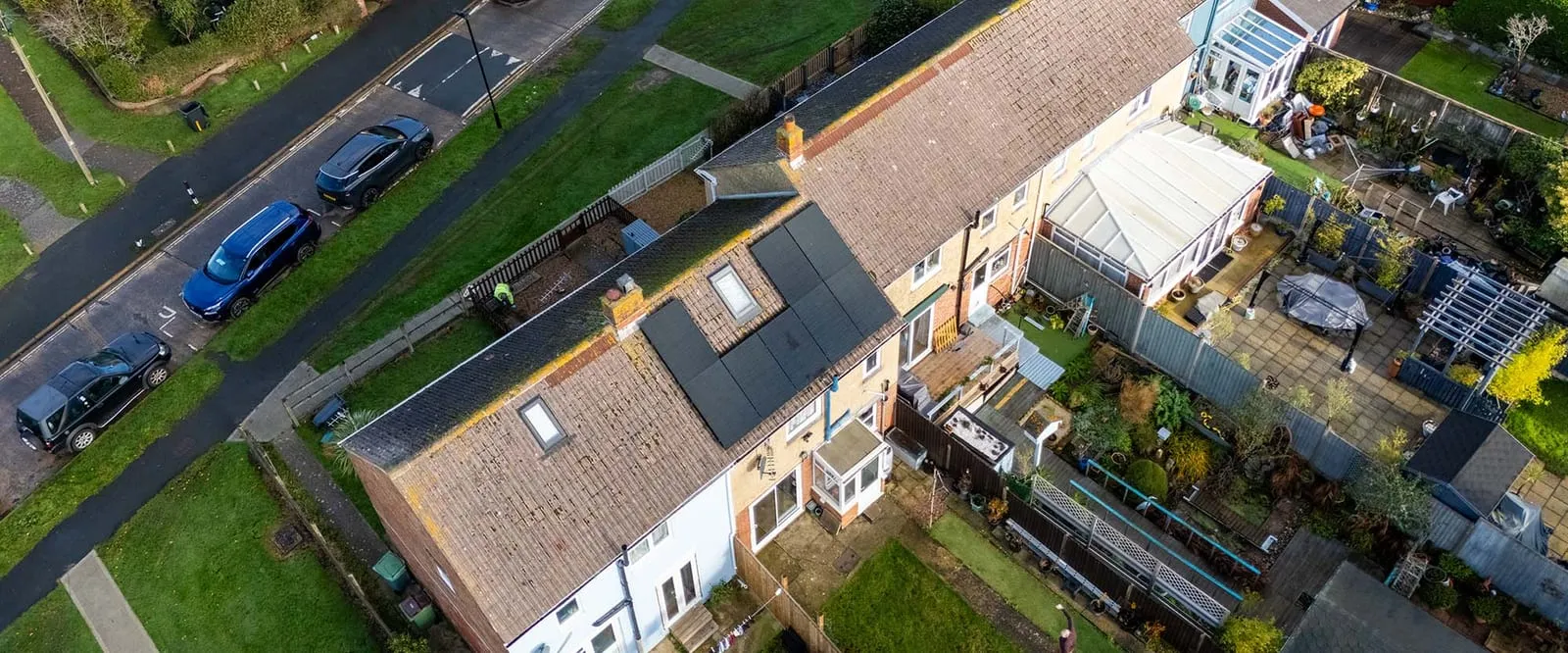
Commercial solar procurement in the UK doesn’t run on the same rails as domestic. There’s no consumer-style “get three quotes and pick the cheapest” cycle — instead there’s a framework, a due-diligence pack, a finance decision, and increasingly, a buyer who has already searched the exact building type before they’ve spoken to a single installer. For commercial solar installers trying to win share of a market that grew installs by 32% in 2025, understanding how commercial buyers actually procure — and where they look first — matters more than having the best price per kWp.
The commercial buyer isn’t the domestic buyer
A homeowner researching solar compares three quotes on price and payback. A facilities manager, finance director, or estates team procuring for a warehouse, school, or care home is working through a completely different process: capital sign-off, competing framework routes, insurance and warranty scrutiny, and — increasingly — a requirement that the installer has done this exact building type before.
That last point is the one most installers underweight. A procurement team evaluating solar for a 40,000 sq ft distribution shed doesn’t want a generalist. They want evidence the installer understands racking loads on a standing-seam roof, fire-service access routes around array layouts, and how a solar array interacts with an existing BMS. The installers winning commercial work in 2026 are the ones who’ve built a visible track record in a specific property type — hospitals, schools, warehouses, care homes — rather than a generic “we do commercial too” tab bolted onto a residential site.
Framework routes: where the contracts actually sit
Most public-sector and a meaningful share of larger private commercial solar contracts don’t get procured through open tender at all — they move through frameworks. NHS trusts, local authorities, MATs (multi-academy trusts) and housing associations typically buy via established procurement frameworks (Crown Commercial Service, YPO, ESPO, Fusion21, Procure Partnerships, and similar regional variants) rather than running a bespoke OJEU/PCR2015-style tender for every roof.
For an installer, this changes the whole go-to-market:
- Framework accreditation is the gate, not the differentiator. Being on the right framework gets you in the room; it doesn’t win the job. Most competitors on a framework lot are also MCS-certified, also NICEIC, also carrying the right insurance minimums.
- Referencing wins the shortlist. Framework call-off processes almost always ask for case studies against the specific asset class — three hospital installs, five school roofs, two cold-storage warehouses. Generic domestic case studies get discarded at the first filter.
- Direct-award thresholds matter. Many frameworks allow direct award below a defined value threshold (varies by framework and lot, but often somewhere in the low-to-mid six figures), meaning smaller commercial jobs — a single warehouse, a standalone care home — can bypass full mini-competition if the buyer already trusts the installer. This is exactly why repeat referencing inside one property type compounds: win one care home job well, and the operator’s estates team will often direct-award the next three.
For private commercial buyers outside frameworks — landlords, PLCs, owner-occupiers — procurement is closer to domestic in process (RFQ, site survey, competing quotes) but the evaluation criteria shift toward covenant strength, warranty backing, and financing structure. A landlord evaluating solar for a multi-let industrial estate cares as much about who underwrites the O&M contract for years 11–25 as they do about the headline £/kWp.
Referencing and the property-type niche play
Here’s the structural opportunity most commercial installers miss: generalist commercial solar content ranks worse than property-type-specific content, both in search and in procurement evaluation. A buyer searching for solar on a warehouse roof is looking for evidence of racking-load calculations, roof penetration methods for standing seam versus built-up felt, and case studies from similar-sized sheds — not a homepage that mentions “commercial and industrial” in passing.
The same pattern holds across every vertical:
- Schools and colleges — procurement almost always runs through MAT central teams or local authority frameworks, with safeguarding-adjacent scheduling (works during holidays only) and DfE condition-funding overlap. An installer who can show they’ve navigated school and college procurement cycles — including how solar interacts with condition improvement fund bids — has a structural edge over a generalist quoting the same job cold.
- Hospitals and NHS estates — infection control, clinical continuity during installation, and NHS Net Zero targets all shape the brief. Hospital and NHS solar work needs referencing that speaks directly to those constraints, not generic commercial case studies.
- Care homes — CQC-registered operating constraints (noise, access, resident welfare during works) plus energy-cost pressure make care home solar a distinct niche with its own procurement rhythm, often through group-operator estates teams rather than site-by-site.
- Farms and agricultural buildings — a completely different funding and roof-type conversation (Improving Farm Productivity grant support at around 25% of eligible cost in England, plus separate barn-roof structural considerations), covered in detail on solar for farm buildings and barn-specific installs.
- Restaurants and hospitality — smaller footprint, faster payback expectation, and a buyer who wants disruption-free installation around trading hours — the brief covered on restaurant solar.
- New-build developments — a fundamentally different procurement conversation, usually with a developer or NHBC-registered contractor rather than an end operator, and increasingly shaped by Future Homes Standard compliance — see new-build solar.
- Office buildings — landlord/tenant split incentive problems dominate, plus MEES (Minimum Energy Efficiency Standards) compliance deadlines pushing EPC-driven retrofit decisions — detailed on office building solar.
The installers building genuine authority in a single property type — rather than spreading thin across all of them — are the ones showing up when a facilities manager searches “solar installer for [our building type]” instead of the generic term. That specificity does double duty: it wins the search visibility, and it’s the exact referencing evidence procurement panels ask for.
Car parks and canopies: a growing structural niche
Solar carports and canopy structures over car parks are a distinct commercial sub-market with their own planning, structural engineering, and EV-charging-integration requirements — increasingly relevant as employers and retail sites add destination charging. Solar car park canopy projects sit at the intersection of estates management, planning permission (canopies over parking are treated differently to roof-mount under most local plans), and EV infrastructure procurement — a three-way conversation that a roof-only installer often isn’t set up to have.
Finance is now part of the procurement conversation, not an afterthought
With 0% VAT on residential solar and battery storage running until 31 March 2027, domestic economics get most of the media attention. Commercial buyers face a different calculation: no VAT relief equivalent, capital allowances considerations, and — for larger sites — a genuine choice between capex purchase, asset finance, and a Power Purchase Agreement (PPA) structure where a third party owns and maintains the array and the site simply buys the generated power at a discount to grid rate.
This is where procurement and financing have become inseparable. A facilities team evaluating a 250kW rooftop array increasingly wants the installer (or the installer’s finance partner) to present capex, asset finance, and PPA as three parallel options in the same proposal — not as a separate conversation after the technical spec is agreed. Installers who can only quote capex are self-eliminating from a growing share of tenders where the buyer’s finance team has already decided off-balance-sheet is the preferred route. Related reading on structuring the deal itself sits on commercial solar finance and solar panel grants for businesses, which covers what limited grant support still exists (predominantly sector-specific, not a general commercial solar grant).
Battery storage is following the same pattern on the commercial side: battery storage for business procurement now sits alongside the generation array as standard scope on anything over roughly 100kW, driven by demand-charge avoidance and increasingly by grid connection constraints — many DNO regions are capping new export capacity, making storage-plus-curtailment a design requirement rather than an optional extra.
What this means for installer marketing and business development
Pulling the threads together, three things separate installers winning commercial contracts consistently from those chasing them one tender at a time:
- Framework presence plus property-type referencing, not framework presence alone. The accreditation is table stakes; the case-study depth in one vertical is the differentiator.
- Finance fluency. Being able to walk a client through capex versus asset finance versus PPA in the same meeting, rather than routing them to a third party, keeps the installer central to the decision.
- Search visibility that matches the buyer’s actual search behaviour. Facilities managers search by building type, not by “commercial solar installer near me.” Content and case studies organised the same way the buyer searches — by property type — consistently outperforms generalist commercial pages.
On the ground, several regional installers are already building this kind of vertical depth. Doncaster-based Electrifusion Solutions has built out commercial and domestic work across South Yorkshire; EC Eco Energy in Essex has leaned into commercial solar and battery for East Anglian businesses; and D&R Energy in Bristol focuses specifically on commercial-scale projects rather than splitting attention with residential volume. On the domestic-adjacent side, installers like ECO Aim in Livingston and Greenlinc Renewables in Lincolnshire show how MCS-certified regional installers are extending from domestic into small commercial and agricultural work using the same referencing logic — proof from one job type opens the door to the next.
For deeper background on how the underlying economics are shifting the buyer conversation, see our sister sites’ work on UK solar industry trends for 2026 and, for installers building out their own commercial pipeline, solar installer marketing. On pricing specifics that come up constantly in commercial RFQs, commercial solar panel costs breaks down the £900–£1,200/kWp range installers should be quoting against.
The wider pattern across the 2025 MCS data — 257,397 installs, up 32% year-on-year, and roughly 21.6GW of cumulative deployed capacity — shows a market still weighted heavily toward domestic volume. Commercial is the smaller but higher-value slice, and it’s being won less on price than on whether the installer can prove, with real referencing, that they’ve solved this exact building type’s procurement, structural, and financing questions before.
The practical takeaway
Winning commercial solar contracts in 2026 isn’t about being the cheapest quote in a mini-competition. It’s about being on the right framework, having referencing depth in a specific property type, and being able to present capex, asset finance and PPA options in the same conversation as the technical spec. Installers who narrow their commercial pitch to a niche — warehouses, schools, care homes, farms — and build visible proof in that niche are consistently out-competing generalists chasing every commercial lead that comes in.