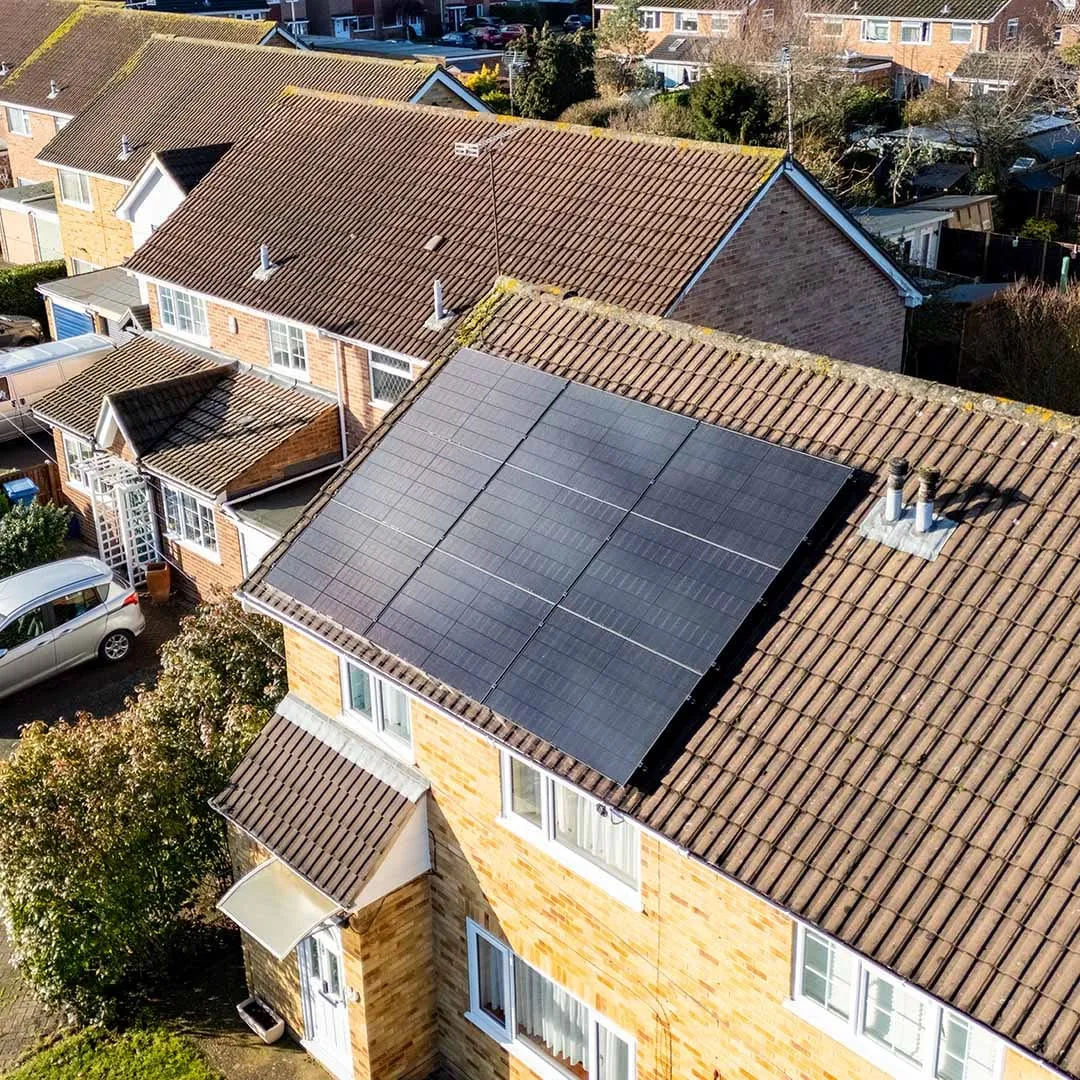
The volume housebuilders spent a decade treating solar as an optional upgrade. That era is over. The Future Homes Standard has turned rooftop generation into a near-default spec on new-build plots across England, and the developers who move fastest on procurement — not just compliance — are the ones locking in the margin before their competitors catch up. For installers used to selling one system at a time to homeowners, the new-build channel is a different discipline entirely: framework tenders, phased handover schedules, and volumes that make or break a regional business in a single contract award.
Why new-build solar stopped being optional
The direction of travel has been clear since the Future Homes Standard consultation closed, and the practical effect for developers is that low-carbon heating and on-site generation are now baked into building regulations compliance for new dwellings, rather than being a marketing add-on. Combined with 0% VAT on residential solar and battery storage installations across Great Britain (in place until 31 March 2027, after which it’s scheduled to revert to 5%), the economics of specifying solar at construction stage — rather than retrofitting after sale — have shifted decisively in the developer’s favour.
That distinction matters more than it sounds. A retrofit sale to an existing homeowner is a single-property, single-decision-maker transaction that can take weeks of lead generation, quoting and follow-up to close. A framework win with a regional housebuilder can deliver 40, 200 or 2,000 roofs off the back of one procurement cycle — with the developer handling the sales conversation, the installer handling delivery. The margin per roof is typically tighter than retrofit, but the cost of customer acquisition drops to close to zero once you’re on the panel.
For installers weighing up whether to chase this channel, the honest comparison is covered in more depth on solarpanelsfornewbuilds.co.uk, which sets out how new-build solar economics differ from the retrofit market most residential installers are built around — worth reading before quoting your first framework tender.
Framework procurement is not a retrofit sales process
This is the part that catches installers out. Selling to a homeowner and selling to a developer’s procurement team are almost unrelated skills.
Retrofit sale:
- One decision-maker, often influenced by a partner
- Sales cycle measured in days to weeks
- Price sensitivity is emotional as much as financial
- Single-site logistics, one survey, one install
- Payment on completion, retail margin
Framework procurement:
- Multiple stakeholders — procurement, technical director, site managers, NHBC/warranty providers
- Tender cycle measured in months, sometimes a full financial year
- Price sensitivity is spreadsheet-driven: cost per kWp, cost per plot, cost per phase
- Multi-site logistics synced to build programme, often 20-80 plots per phase
- Staged payment against SAP/EPC milestones, contractor margin not retail margin
Developers procuring for a Future Homes Standard-compliant plot aren’t asking “will this save me money on my electricity bill” — they’re asking whether the specified system meets the target SAP rating, whether the installer can deliver to a build schedule without holding up plot completions, and whether the paperwork (MCS certification, building control sign-off, warranty documentation) will be clean enough to not create snagging headaches six months after handover. MCS certification is non-negotiable here — it’s both the mechanism that keeps the developer’s EPC calculations valid and the route to Smart Export Guarantee eligibility for the eventual homeowner, so any framework bid without a live MCS number attached is dead on arrival.
Getting onto a regional developer’s approved contractor list typically means demonstrating: public liability and professional indemnity cover at commercial levels, a named site supervisor structure (not just installer teams), NHBC or equivalent warranty compatibility, and — increasingly — a track record of phased delivery references. Housebuilders check references from other developments before they check price.
In-roof at volume: the technical shift installers need to plan for
Retrofit installers are, overwhelmingly, on-roof specialists: rails, clamps, a system bolted over existing tiles or slates. New-build changes that calculus completely, because in-roof (integrated) systems are now the default spec on a large share of Future Homes Standard plots — partly for aesthetics on show homes, but mainly because it’s genuinely cheaper to specify in-roof at the point of construction than to batten and tile a roof and then retrofit an on-roof array afterwards.
That has real operational consequences for an installer trying to win framework work:
- Different fixing systems and a different skill set. In-roof trays, flashing kits and weatherproofing details vary significantly between manufacturers, and getting them wrong on a live build site — where the roofer, the scaffolder and your solar team are all on programme against the same completion date — is a much bigger reputational risk than a callback on a single retrofit job.
- Sequencing against the build programme. On a retrofit job, the installer controls the schedule. On a new-build phase, the solar install has to slot into a sequence set by the site manager, usually after roofing and before render/scaffold strike. Missing your slot on a 40-plot phase doesn’t just delay one roof — it can hold up the whole handover schedule, and developers remember which subcontractors do that.
- Standardisation over customisation. Retrofit quoting is bespoke per property. Framework delivery works from a small number of standardised house-type specifications repeated across hundreds of plots, which rewards installers who can pre-configure kit lists and crew rotas rather than survey and design from scratch every time.
- Battery and EV-ready wiring as a package, not an upsell. Many developer specifications now bundle battery-ready consumer units and EV charge point pre-wiring alongside the PV array as one package, reflecting where Future Homes Standard compliance is heading on electrification more broadly — installers who can only quote the panels, not the fabric around them, are less attractive to a developer trying to simplify their supply chain.
Installers building out regional new-build capability alongside retrofit work are worth watching here — firms like premierelectricalrenewables.co.uk, which already combines solar, battery and EV charging under one contractor relationship, are structurally closer to what a developer’s procurement team wants than a solar-only specialist. The same logic applies to electrical-and-renewables combination firms more broadly: hazellelectrical.co.uk in West Kent and yeers.co.uk across Yorkshire both operate the electrical-plus-renewables model that reads well on a developer’s approved contractor list, because it removes one subcontractor relationship from the site manager’s list rather than adding one.
What the numbers actually look like
Volume changes the maths, and installers quoting framework work for the first time consistently underestimate how thin developer-facing margins run compared with retrofit. A typical 4kW residential system installed retrofit runs roughly £6,000-£8,000 including VAT relief; at new-build volume, procured across dozens or hundreds of near-identical plots with materials bought in bulk and labour scheduled efficiently, the effective cost per plot for the developer is materially lower — though the installer’s margin per unit compresses accordingly. That’s the trade: lower unit margin, dramatically lower cost of sale, and a payment schedule tied to build milestones rather than one-off completion.
Commercial-scale procurement follows a similar logic at a different order of magnitude — costs in the region of £900-£1,200 per kWp are typical for larger commercial installations, and developers building mixed-use or later-phase commercial units on a residential scheme sometimes procure both under a single contractor relationship. Installers wanting the fuller cost breakdown across scales should see our own cost guide, and for the commercial end specifically, commercialsolarpanelsinstallation.co.uk covers procurement patterns on the larger-format side of the market that increasingly overlaps with major residential developments.
Export economics are worth flagging to developers too, since Smart Export Guarantee rates vary by supplier — typically in a 12-20p/kWh range at the better end — and are not a fixed national tariff. Developers marketing the “solar-ready” credentials of a new estate to buyers benefit from installers who can explain this accurately rather than quoting a single headline number that won’t hold up when a homeowner rings their own supplier eighteen months later.
Where the regional opportunity sits right now
Framework procurement tends to cluster regionally around where housebuilders are actively building out large sites, and installers with existing commercial and multi-site delivery experience are best placed to bid. In South Yorkshire, electrifusionsolutions.com and ampproelectrical.co.uk both operate from a Doncaster base into a region seeing sustained new-build activity along the M18/M1 corridor. In Central Scotland, ecoaim.co.uk is positioned for the Livingston and Central Belt new-build pipeline, an area where Scottish building standards are running their own parallel tightening on new-build energy performance. In Lincolnshire, greenlincrenewables.co.uk — MCS-certified and already embedded in the county’s solar market — sits well for the East Midlands housebuilding corridor. And in South Wales, fldelectrical.co.uk covers a Swansea-based market where Welsh building regulations have moved in step with, and in some respects ahead of, the England-only Future Homes Standard timeline.
None of these firms need to abandon retrofit to chase framework work — the sensible model, and the one the more established EMD-side developer resources point installers toward, is running both channels in parallel: retrofit for margin and brand, framework for volume and pipeline stability. For agricultural and rural new-build schemes specifically, solarpanelsforfarms.uk and solarpanelsforbarns.co.uk cover the barn conversion and rural residential development niche, which sits slightly outside standard Future Homes Standard housebuilder frameworks but follows a similar procurement logic with smaller, more relationship-driven developers.
The practical next step for installers
Getting onto a developer framework isn’t a marketing exercise — it’s an operations and compliance exercise dressed up as one. The installers winning this work in 2026 are the ones who went and got their MCS certification, PII cover and NHBC compatibility sorted before they pitched, not after a developer asked for it. If your business is still structured entirely around individual retrofit sales, the honest first move is a smaller regional developer or a self-build/custom-build scheme — lower volume, lower barrier to entry, and a reference project you can put in front of a bigger housebuilder’s procurement team next time round. Chase the framework work with the paperwork already in order, and the volume takes care of itself.