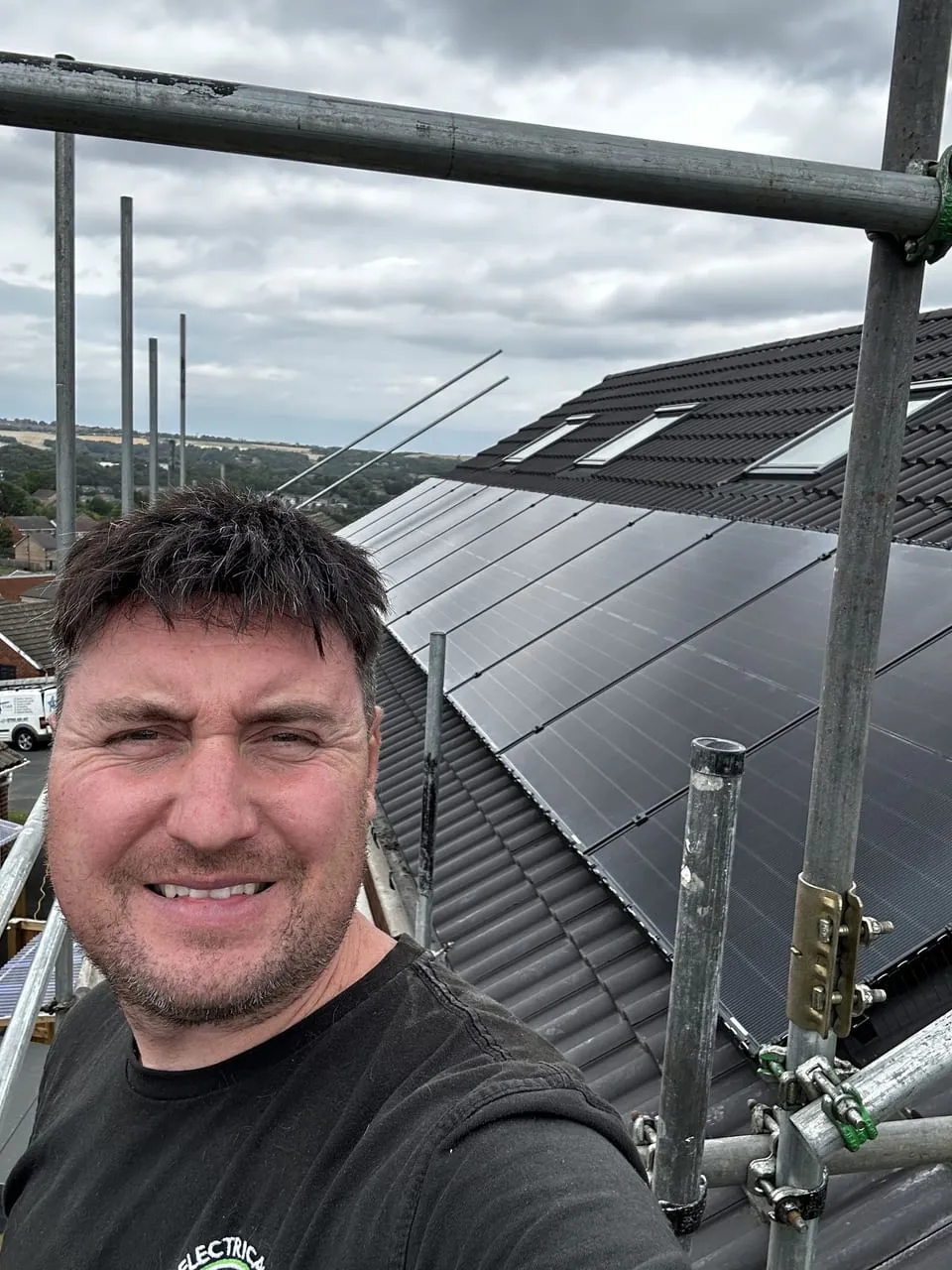
Commercial rooftop and ground-mount solar has stopped being a sustainability add-on for UK businesses and become a straightforward capital allocation decision. With grid electricity still sitting around 25p/kWh for many commercial tariffs and a wall of compliance deadlines landing in 2026-2027, the investment case has moved from “nice to have” to “why haven’t you done this yet.” Here’s what the data says about where the market goes next.
Where the market stands going into 2026
The UK closed 2025 with a genuinely record year. MCS certified 257,397 small-scale solar installations across the year — up 32% on 2024 — with rooftop installs alone (267,032) beating the previous 2011 feed-in-tariff-boom record by 31%. Total UK solar capacity now sits at roughly 21.6 GW, delivering around 6.4% of the country’s electricity.
That headline figure is dominated by domestic volume, but the commercial and industrial segment is where the capacity is concentrated. A single 250 kWp warehouse roof does more for decarbonisation math than fifty 4kW semis, and it’s commercial rooftop, ground-mount, and canopy projects that are absorbing the bulk of new investment capital moving into 2026.
Analysts at Solar Media expect the market to add a further 5-5.5 GW in 2026 alone — more than double the roughly 2.6 GW added in 2025 — as the government’s roadmap targets 45-47 GW of total installed solar capacity by 2030, effectively doubling today’s base in under four years. Hitting that trajectory requires sustained annual additions well above anything the UK has managed historically, and commercial-scale deployment (10 kWp to multi-MW) is the segment expected to carry the heaviest share of that growth, given the practical ceiling on how much domestic roof space is left to fill.
The three drivers actually moving procurement decisions
1. Energy costs that haven’t gone back down. Commercial electricity pricing has stayed structurally high since the 2022 gas shock, and even with wholesale prices off their peak, businesses on out-of-contract or renewal rates are routinely paying well above pre-crisis levels. For any site with meaningful daytime consumption — manufacturing, cold storage, retail, hospitality — a well-sized solar array converts a chunk of that spend from a variable cost into a fixed, depreciating capital asset. Payback periods for commercial systems are now commonly landing in the 4-7 year range depending on self-consumption profile, against a 25-30+ year panel lifespan for modern N-type modules degrading at roughly 0.4% a year.
2. Capital allowances, not grants. There’s a persistent myth that commercial solar gets “free money” from government. It doesn’t — there’s no universal grant for business solar. What exists instead is tax timing relief: the Annual Investment Allowance lets a business deduct up to £1 million of qualifying capital expenditure, including solar installations, from taxable profits in the year of purchase. On a £100,000 system, that’s a £25,000 corporation tax saving in year one for a business paying the standard rate — not free, but a meaningful acceleration of return. Solar sits in the special-rate pool rather than qualifying for full expensing, so it’s the AIA route that does the work, and it’s one of the clearest reasons finance directors are pulling projects forward into the current tax year rather than deferring them. The commercial solar finance route — asset finance, PPAs, or leasing structures — is increasingly how mid-market businesses are funding installations without a capex hit to the balance sheet.
3. Compliance deadlines with teeth. The Energy Savings Opportunity Scheme’s Phase 4 qualification date falls on 31 December 2026 — any UK business with 250+ employees, or turnover above £44m and a balance sheet above £38m, is assessed against that date and must notify compliance by December 2027. Solar is one of the few measures that produces an easily measured, easily verified reduction in metered grid consumption, which is exactly what ESOS auditors want to see. Add in mounting pressure from SECR reporting and supply-chain ESG questionnaires from larger customers, and boards that would have deferred a solar decision two years ago are now bringing it forward to get ahead of the audit cycle.
Layered on top of all that is the 0% VAT rate on residential solar and battery storage, which runs until 31 March 2027 before reverting to 5% — a domestic-market lever, but one that’s kept installer capacity and supply chains warm heading into a period where commercial demand is scaling fast.
Sector leaders: where the capital is actually landing
Warehousing and logistics remains the standout sector. Large, flat, structurally simple roofs with minimal shading and daytime-heavy demand (refrigeration, conveyor systems, EV fleet charging) make warehouse rooftops close to the ideal solar asset. Combined with the growth in e-commerce fulfilment floorspace, this sector alone could plausibly account for a meaningful share of new commercial capacity through 2030.
Manufacturing and factories aren’t far behind — process heat and continuous-shift electricity demand mean factory and industrial sites frequently see the fastest payback of any commercial category, and many are now pairing arrays with battery storage to flatten demand charges.
Education and healthcare are becoming a quiet growth pocket. Multi-academy trusts and NHS trusts both sit under long-term public-sector net-zero targets, and estates teams are increasingly running solar business cases across entire school and hospital portfolios rather than site by site — see the scale of activity now visible across school solar and NHS and hospital estates procurement.
Hospitality, care, and offices round out the mid-market. Hotels with high daytime and shoulder-season demand, care homes with 24-hour baseline load, and offices increasingly under landlord ESG pressure are all showing up more often in installer pipelines than they were three years ago.
Car parks and land-constrained sites are the segment to watch for 2027-2030. Where roof space is exhausted or unsuitable, solar carport and canopy structures let retail parks, hospitals, and logistics parks generate on otherwise idle tarmac while adding EV charging infrastructure landlords increasingly need anyway.
Agricultural buildings are a genuinely under-tapped category. England’s Improving Farm Productivity grant offers around 25% of eligible cost for qualifying farm solar projects — rates and schemes differ across the UK’s nations, so it’s worth checking the current terms rather than assuming a flat figure — and combined with large barn roofs and high seasonal demand from cold storage and irrigation, farm and barn solar is one of the more commercially compelling niches installers are chasing into 2026.
What’s holding the market back
Grid connection queues remain the single biggest brake on commercial-scale deployment. Larger ground-mount and rooftop-plus-battery projects above a few hundred kW are still routinely quoted multi-year connection dates by DNOs in constrained regions, even as reform efforts try to clear the backlog. Skilled installer capacity is the second constraint — MCS-certified installers capable of commercial-scale, three-phase work are in shorter supply than the volume of domestic-scale fitters the 2025 boom created, and MCS certification remains the gatekeeper for Smart Export Guarantee eligibility on any system claiming export revenue. Export rates themselves are worth a reality check too: SEG tariffs vary by supplier, typically ranging from a few pence up to around 15-20p/kWh at the best end, not a fixed national rate — so commercial system sizing should be built around maximising self-consumption first, export second.
Regional installer activity backs up the national numbers
The growth isn’t evenly distributed, and installer pipelines across the country reflect that. In the East Midlands, Greenlinc Renewables sister firms and peers report a steady shift toward larger commercial enquiries alongside domestic work, while in South Yorkshire, ElectriFusion Solutions has seen commercial and light-industrial jobs make up a growing share of its Doncaster-area workload. Further north, Ecoaim in Livingston is fielding more Central Scotland business enquiries as Scottish commercial tariffs track the same upward pressure as the rest of the GB market, and in the South West, D&R Energy has built a Bristol-based practice specifically around commercial-scale installations rather than domestic retrofits. That regional spread — not just a handful of national contractors — is one of the clearer signs this is now a mainstream capital-expenditure category rather than a niche.
The 2026-2030 outlook in one line
If the 45-47 GW 2030 target is even broadly hit, the UK needs to more than double its total installed base in roughly four years, and the arithmetic only works if commercial and industrial rooftop and ground-mount deployment scales faster than domestic. That’s a substantially different market to the one installers were selling into during the 2025 residential boom — bigger systems, longer sales cycles, finance-led rather than grant-led decision-making, and procurement driven as much by the finance director and the ESOS auditor as by the estates manager. For a fuller breakdown of the pricing side of that shift, see our commercial solar panel cost guide on the cost-of-solar side of the network, and for installer-facing detail on where the 2025 residential record actually came from, our earlier UK solar industry 2026 data review covers the domestic side of the same story.
For businesses weighing up a first commercial system, the honest starting point is a site-specific yield and load analysis rather than a generic ROI table — self-consumption profile, roof or land constraint, and grid connection timeline vary enough between sectors that a warehouse case and a care-home case can produce very different paybacks from an identical kWp figure. But the direction of travel for 2026-2030 is not in serious doubt: more capital, more sectors, and a market that’s shifted from early-adopter enthusiasm to mainstream financial planning.