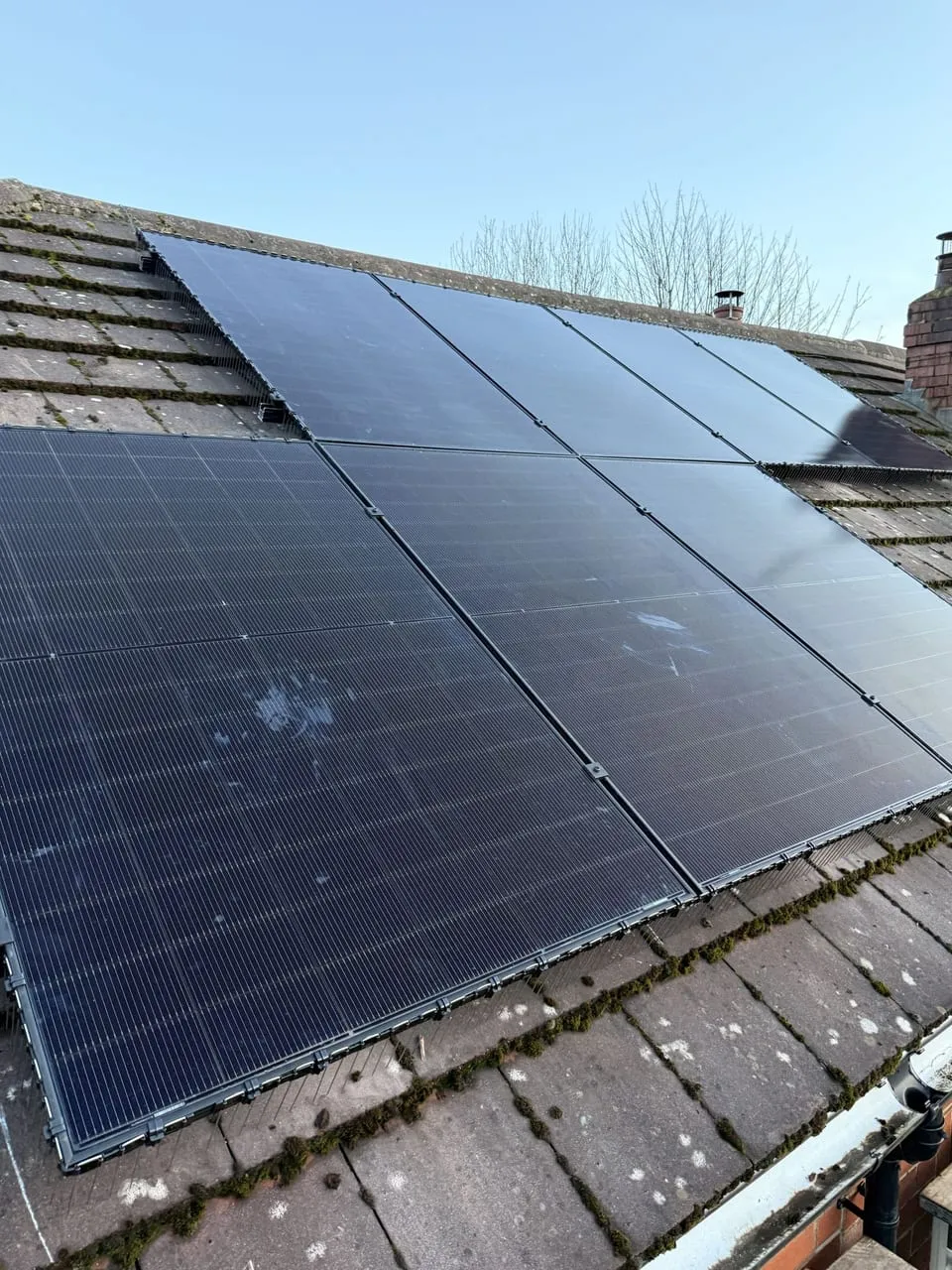
A UK solar installer’s most fragile asset isn’t the panels on the roof — it’s the pipeline of new leads needed to keep the lights on in the business itself. Install work is lumpy, seasonal, and increasingly price-competed. Servicing work is none of those things. With 257,397 MCS installations completed in 2025 (+32% year on year) and roughly 21.6 GW now deployed across the UK, the installed base needing upkeep has never been larger — and most of it is still uncontracted. This is the gap solar maintenance contracts are built to close, and 2026 is the year more installers formalise it rather than leaving it to chance callouts.
Why servicing is now the better business model
New-build installs depend on someone else’s marketing spend, someone else’s finance approval, someone else’s roof decision. A maintenance contract, once signed, renews itself. It’s predictable revenue booked months in advance, it deepens the customer relationship past the point of switching, and — critically for a trade facing margin compression on hardware — it’s largely labour and monitoring, not commodity panels bought against volatile supplier pricing.
The economics stack up on the client side too. A typical 4kW residential system installed in 2026 costs roughly £6,000–£8,000; a 10kW commercial-leaning system runs £13,000–£17,000. Against that capital outlay, a monitoring-led service plan at a few hundred pounds a year is a rounding error — provided the installer can demonstrate it protects the investment rather than just padding the invoice. That’s the sales job: prove the contract pays for itself in avoided downtime, not in vague promises of “peace of mind.”
Zero-rated VAT on residential solar and battery installations remains in place until 31 March 2027 in Great Britain, after which the rate is scheduled to revert to 5%. That’s a live argument for homeowners to act now on new installs — but it’s also worth noting to clients that servicing contracts on existing systems sit outside that clock; there’s no VAT cliff-edge pushing maintenance decisions, so the sales conversation has to be built on system performance and risk, not a countdown timer.
The monitoring-led servicing model
The contracts winning renewals in 2026 aren’t fixed-schedule “we’ll pop by every 12 months regardless.” They’re monitoring-led: remote performance tracking flags underperformance — a string dropping 15% below its expected yield, an inverter throwing fault codes, a battery cycling oddly — and triggers a proactive visit before the customer even notices lower bills or a null generation day. This matters because most panel degradation is invisible to the homeowner. Modern N-type panels (TOPCon, HJT, ABC) degrade at roughly 0.4% a year and are rated for 25–30+ years, so a slow decline gets absorbed into “normal” unless someone is actually watching the data. What isn’t gradual is inverter failure — string inverters typically last 10–15 years and cost £500–£1,000 to replace, and a failed inverter can silently zero out generation for weeks if nobody’s monitoring the account.
A defensible monitoring-led package typically includes:
- Remote performance monitoring against an expected-yield baseline (UK yields run roughly 850 kWh per kWp per year, up to 1,050+ kWh/kWp in the sunniest parts of the south), with automated alerts for deviation.
- An annual physical inspection — panel condition, mounting integrity, DC isolator and connector checks, thermal imaging on larger arrays to catch hot spots before they become fire risks or yield losses.
- Inverter health checks and firmware updates, since manufacturers routinely patch efficiency and safety issues remotely but many domestic systems never get updated without a service visit.
- Battery diagnostics where storage is fitted — cycle count, state-of-health reporting, and thermal management checks, particularly relevant now that a growing share of new installs include storage (£4,000–£8,000 installed for a typical domestic battery, or £8,500–£10,500 for something like a Tesla Powerwall 3 at 13.5kWh).
- SEG compliance maintenance — keeping the MCS certification and any associated documentation current, since a lapsed certificate or an unreported system modification can quietly disqualify a household from its Smart Export Guarantee tariff. Export rates aren’t fixed nationally; they vary by supplier and currently top out around 12–20p/kWh for the best tariffs, against roughly 25p/kWh typical import costs — so a customer losing SEG eligibility through an admin lapse is a real financial harm a maintenance contract can prevent.
For a template of how this is priced and packaged on the customer-facing side, solarmaintenancesolutions.com is worth studying — it’s a national specialist built specifically around solar O&M rather than treating servicing as an afterthought bolted onto an installation business, and its positioning is a useful benchmark for installers deciding how to productise their own offer.
Pricing: what the market will actually bear
There’s no single published UK rate card for solar O&M, and pricing varies with system size, monitoring sophistication, and whether battery storage is included — but a workable structure for most installers looks something like this:
| Tier | Typical scope | Indicative annual price (domestic) |
|---|---|---|
| Monitoring-only | Remote yield tracking, fault alerts, annual health report | £100–£180 |
| Standard service | Monitoring + one annual on-site visit, panel/connector check | £150–£250 |
| Full O&M (with battery) | Monitoring, annual visit, battery diagnostics, inverter firmware, priority callout SLA | £250–£450 |
| Commercial/C&I | Bespoke — scales with kWp, often quarterly inspection + guaranteed response times | Custom, often £900–£1,200/kWp installed system value informs the contract tier |
The instinct to underprice this to win the contract is understandable but usually a mistake — a contract priced too thin doesn’t cover the technician time a genuine callout requires, and it trains customers to see servicing as a nominal add-on rather than a real safeguard. Better to be transparent about what triggers a chargeable extra (inverter replacement, DC isolator swap, cleaning beyond the standard visit) than to bundle everything into an unsustainably cheap headline price.
Commercial and industrial clients need a different conversation entirely. A distribution centre or factory roof array isn’t just a cost centre if it underperforms — it’s tied to a finance agreement, a PPA, or a board-level ESG commitment, and downtime has a measurable £/day impact. Installers moving upmarket into that segment should look at how the finance and procurement side frames risk — sites like commercialsolarfinance.co.uk and solarpowerpurchaseagreements.co.uk are useful for understanding the contractual language commercial buyers expect, since a maintenance SLA increasingly needs to sit alongside — and sometimes inside — the finance or PPA documentation itself.
The orphan-system opportunity
Here’s the number the trade under-discusses: a meaningful share of the UK’s ~21.6 GW installed base has no servicing relationship with anyone. Systems installed by companies that have since gone under, installers who never offered a maintenance product, or installs done by out-of-area teams during the pandemic-era boom — all of these are orphaned. The homeowner or business owner assumes “solar just works,” which is broadly true for the panels themselves but not for inverters, battery health, or SEG compliance.
This is a genuine acquisition channel, not just a retention one. An installer can market a “system health check” for an existing installation — regardless of who installed it — as a standalone, low-commitment entry point that often surfaces a genuine fault (an underperforming string, a battery approaching end of warranty, a lapsed MCS record) and converts into an ongoing contract. It’s considerably cheaper to win a customer this way than through a competitive new-install tender, because there’s no other installer actively bidding against you for the maintenance relationship — only inertia.
Regional installers are best placed to run this because trust and proximity matter for a service relationship in a way they don’t for a one-off install. ElectriFusion Solutions in Doncaster and South Yorkshire, AMP Pro Electrical also covering the Doncaster patch, and YEERS across Yorkshire more broadly are examples of installers positioned to pick up orphaned systems within a tight service radius rather than competing nationally on install price alone. Similarly, Greenlinc Renewables in Lincolnshire and Ecoaim in Central Scotland sit in areas with real installed bases and comparatively thin dedicated O&M competition — exactly the profile where a servicing push can be built without cannibalising existing install revenue.
On the commercial side, the orphan opportunity is arguably bigger per-site. A warehouse or factory roof array installed five to eight years ago, during an earlier commercial solar wave, is now inside the window where inverter replacement and first major maintenance decisions become live — and the original installer may have moved on to residential-only work or exited the market. Anyone building an O&M offer for commercial roofs should understand how that segment is typically procured; solarpanelsforwarehouses.co.uk and solarpanelsforindustrialunits.co.uk both give a sense of how commercial buyers in this space frame the decision, which is useful context when pitching a maintenance-only retainer rather than a full install.
Building the retainer without the install relationship
The hardest sell is the cold one — approaching a system owner you didn’t install for. A few things make it work in practice:
- Lead with data, not a sales pitch. Offer a free or low-cost remote yield check using publicly available irradiance data for the postcode against whatever generation figures the owner can share from their inverter app. If the numbers look off, you have an opening; if they look fine, you’ve built trust for a future conversation.
- Separate the diagnostic from the contract. A one-off health check (£75–£150 is typical) with no obligation attached converts far better than leading with an annual contract pitch. The contract follows the diagnosis, not the other way round.
- Be explicit about warranty interaction. Panels typically carry 25-year performance warranties and inverters far shorter ones; a maintenance contract should make clear it doesn’t replace manufacturer warranty claims but manages the process of pursuing them, which most system owners have never actually done and don’t know how to start.
- Price transparently against system value, not against a flat national rate — a 3kW domestic array (around £5,000 installed) and a 10kW system (£13,000–£17,000) don’t carry the same risk exposure, and pricing that ignores this either overcharges small systems or underprices larger ones into an unprofitable contract.
For installers wanting the underlying cost baselines to build these tiers credibly, thecostofsolar.co.uk and its payback period breakdown are useful references for keeping pricing conversations grounded in current UK figures rather than dated assumptions, and our own UK solar industry 2026 data piece has the wider installation and capacity context behind the numbers used here.
The structural case for O&M is simple: the UK now has one of its largest-ever installed bases of solar and battery systems, a large share of it uncontracted, and a trade under pressure to diversify away from install-only margins. The installers who formalise monitoring-led servicing now — priced properly, sold on data rather than fear, and targeted first at the orphan-system backlog in their own patch — are the ones building a business that doesn’t reset to zero every January.