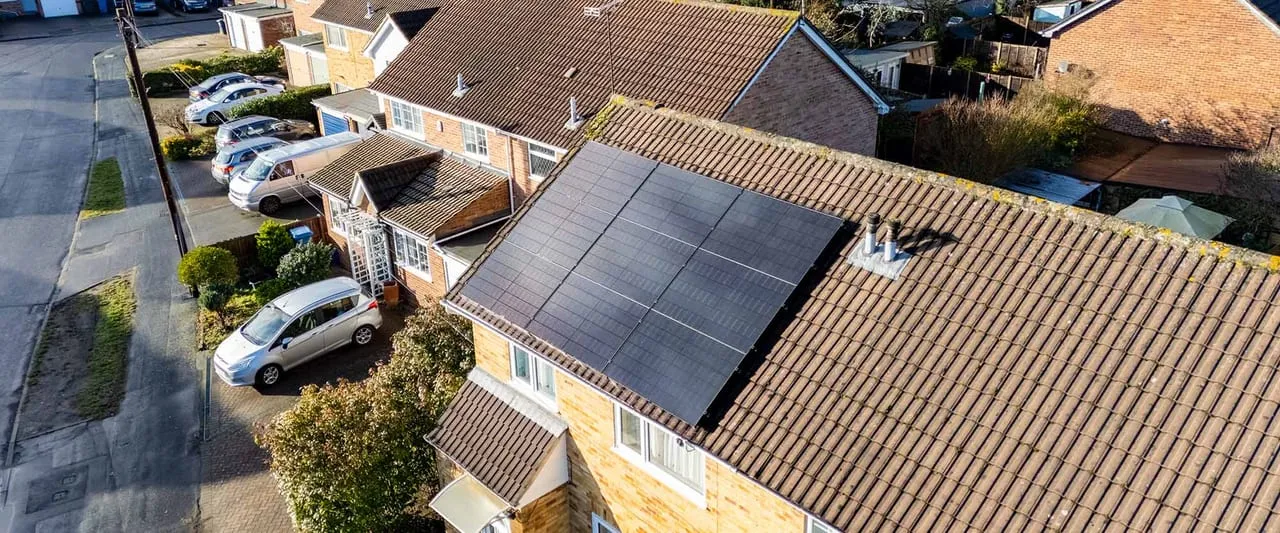
London’s push to hit net-zero by 2030 is no longer just a line in a Greater London Authority (GLA) strategy document — it’s starting to show up as live procurement on industrial estate roofs across the capital. For installers, investors and anyone tracking where UK solar demand is actually landing next, london commercial solar is a market worth watching closely: a region of 8,908,081 people, average commercial energy spend running around £95,000 a year, and a rooftop solar yield of roughly 980 kWh per kWp annually — comfortably above the UK average of around 850 kWh/kWp. This is a trade read on what’s driving that demand, where the roof pipeline actually sits, and which parts of the installer base are positioned to take it.
The policy backdrop: GLA net-zero 2030 and the London Plan
London’s climate policy runs through two documents that matter for anyone quoting commercial jobs in the capital. The first is the London Environment Strategy, the GLA’s overarching climate framework, which sits behind the Mayor’s target of a net-zero London by 2030 — a full two decades ahead of the UK’s 2050 statutory target. The second, and more operationally relevant for developers and installers, is the London Plan, the GLA’s spatial development strategy, which supports rooftop solar deployment across both commercial and residential building types and sets an expectation that solar PV is considered on major developments coming through planning.
That combination — an aggressive top-line target plus a planning framework that actively backs rooftop PV rather than merely tolerating it — is what separates London from most UK regions on the demand side. Local authority procurement, university and public-sector estates, and increasingly private landlords responding to planning conditions are all being pulled toward solar as a default spec rather than an optional extra. For installers used to chasing individual leads, this is a market where policy is doing some of the lead generation for you — provided you’re positioned to bid into it.
Commercial operators researching the fundamentals of that shift can go straight to solar for businesses in London for a London-specific breakdown of what’s driving commercial uptake, or to the dedicated commercial solar panels London hub for a capital-focused walk-through of system types and specification. Commercial Solar London also carries a locally-focused overview aimed squarely at businesses weighing up a rooftop array in the city.
London Energy Efficiency Fund: the public-sector pull
Underneath the planning framework sits a financing mechanism that’s easy for trade audiences outside London to miss: the London Energy Efficiency Fund (LEEF), which provides finance to public buildings to help fund energy efficiency and renewable energy retrofits, including solar PV. This matters commercially because it means a meaningful slice of London’s near-term pipeline isn’t waiting on a private landlord to find capex — it’s public-sector estate (schools, leisure centres, council buildings, NHS sites) where funding has already been structured to move projects from feasibility to installation. Installers with public-sector procurement frameworks in place, or the compliance paperwork to bid into them, have a real edge here that pure private-sector specialists don’t.
It’s also worth flagging to clients directly: the specialist solarpanelsforschools.co.uk and solarpanelsforhospitals.co.uk sites cover exactly this kind of public-estate procurement in more depth, for anyone advising a council or NHS trust on where solar sits within a wider LEEF-backed retrofit programme.
The numbers: yield, spend and payback in the capital
London’s solar yield of roughly 980 kWh/kWp/yr is a genuinely useful selling point against the national average — it sits closer to the “sunny south” upper band (up to ~1,050+ kWh/kWp/yr in the best UK locations) than to the ~850 kWh/kWp/yr baseline most of the country works with. Combined with an import electricity price around 25p/kWh under the current Ofgem cap, that yield advantage translates directly into faster payback on commercial arrays than in most of the country.
A simple illustrative example, using only the figures above: a 50kWp rooftop array at a typical London commercial installed cost of roughly £900–£1,200/kWp (so £45,000–£60,000 total) generating at 980 kWh/kWp/yr produces around 49,000 kWh annually. At full self-consumption and 25p/kWh, that’s roughly £12,250 a year in avoided grid purchase — a simple payback in the 4–5 year range before accounting for any export income or degradation. Given that average commercial energy spend across the capital sits at around £95,000 a year, even a partial offset from a roof array represents a material line-item saving worth putting in front of a finance director.
One accuracy point trade audiences should keep straight when quoting: the 0% VAT relief on solar and battery storage (in place in Great Britain until 31 March 2027) applies to residential installations, not commercial ones. Commercial solar and battery installs are typically standard-rated. That doesn’t kill the economics — London’s yield and energy-spend numbers do the heavy lifting regardless — but it’s a distinction worth being explicit about with commercial clients who’ve heard about the VAT holiday from residential marketing and assume it applies to their premises too.
| London commercial solar — key figures | |
|---|---|
| GLA net-zero target | 2030 |
| Climate framework | London Environment Strategy |
| Planning framework | London Plan — supports rooftop PV, commercial & residential |
| Public-estate finance | London Energy Efficiency Fund (LEEF) |
| Regional solar yield | ~980 kWh/kWp/yr |
| Avg commercial energy spend | ~£95,000/yr |
| Avg London house price | ~£720,000 |
| Population | 8,908,081 |
| Key industrial estate pipeline | Park Royal, Brent Cross, Greenwich Peninsula |
For installers who want to model these numbers against a specific client roof rather than working from averages, thecostofsolar.co.uk’s commercial cost breakdown is a useful sense-check on installed pricing bands before you quote.
Where the roof pipeline actually sits: three estates to watch
Trade attention on London commercial solar tends to default to the City and Docklands, but the more useful roof pipeline for installers sits on the capital’s industrial and mixed-use estates, where large flat roofs, single-tenant decision-making and (often) daytime load profiles that match solar generation make for a cleaner commercial case than multi-let city-centre office blocks.
Park Royal — Europe’s largest industrial estate by some measures, and firmly inside London — is the standout. Its stock of large-footprint warehouse and light-industrial units is exactly the roof type solar PV is most cost-effective on: big unshaded areas, straightforward structural surveys, and tenants with daytime energy demand from refrigeration, manufacturing and distribution operations. Installers working this estate should be quoting warehouse-specific specification rather than a generic commercial system — solarpanelsforwarehouses.co.uk and solarpanelsforindustrialunits.co.uk both cover the roof-loading, inverter-sizing and load-matching considerations specific to that building type.
Brent Cross is a different profile — a major retail and now mixed-use regeneration zone, with large-format retail roofs and, increasingly, structured car parking. That combination makes it a strong candidate for solar carport and canopy structures alongside conventional rooftop arrays, particularly as the wider Brent Cross Town regeneration brings new commercial floorspace under planning conditions shaped by the London Plan’s solar expectations. solarcarparks.co.uk is the relevant specialism for canopy and carport structures on sites like this, where ground-mount or rooftop alone doesn’t use the available asset fully.
Greenwich Peninsula rounds out the three — a large-scale mixed-use regeneration site combining commercial, office and residential development, where new-build solar spec is effectively baked in from planning stage rather than retrofitted. For office and mixed-use developers on sites like this, solarpanelsforofficebuildings.co.uk covers the specification differences between office-building solar (lower daytime load factors, more emphasis on export and battery pairing) and industrial-estate solar.
Between them, these three estates give a reasonable proxy for where London’s next wave of commercial installs will be won or lost: large-format industrial (Park Royal), retail-and-carpark mixed use (Brent Cross), and new-build mixed-use regeneration (Greenwich Peninsula). Installers building a London pipeline should be tracking planning applications on all three rather than waiting for inbound enquiries.
The installer landscape feeding the capital
London itself has no shortage of MCS-certified installers, but a meaningful share of the capacity actually delivering commercial jobs in and around the M25 sits in the surrounding Home Counties trade base rather than inside the North/South Circular. That’s not unusual for a capital-city market — site access, scaffolding and parking constraints inside London push a lot of installation crews to be based just outside it — but it does mean the “London installer landscape” is really a wider South East supply chain.
sola-uk.com, based in Hertfordshire and covering the Home Counties, sits in exactly that commuter-belt tier, well placed to service commercial roofs across North and West London including estates like Park Royal and Brent Cross. Further out, hazellelectrical.co.uk covers West Kent and the electrical/renewables work that increasingly comes bundled with commercial solar — DNO applications, distribution board upgrades and EV infrastructure — relevant to South East London and Greenwich-adjacent sites. ececoenergy.com, serving Essex and East Anglia with a commercial solar and battery focus, is a natural fit for the eastern approaches into London including sites near Greenwich Peninsula and the Thames corridor.
For 2025, MCS recorded 257,397 UK installations (up 32% year-on-year) and around 21.6 GW of cumulative deployed capacity, now supplying roughly 6.4% of UK electricity — national context that underlines just how much of that growth capacity needs to land somewhere, and London’s policy backdrop makes it a rational place for installer businesses to be expanding capacity toward. Once a system’s live, ongoing performance monitoring and O&M matters too, particularly on larger commercial arrays with tighter payback assumptions; solarmaintenancesolutions.com specialises in exactly that post-install servicing, and thebritishsolarblog.co.uk’s maintenance guide is a useful primer for clients asking what upkeep actually involves.
Financing the pipeline: PPAs, asset finance and battery attach
Given standard-rated VAT on commercial installs and average energy spend of ~£95,000/yr providing a strong case but not necessarily spare capex, financing structure is doing a lot of the work in converting London commercial interest into signed contracts. Power purchase agreements — where a third party funds and owns the array and the host site simply buys the generated electricity at a discount to grid price — are a natural fit for landlords and multi-let estates who don’t want the capex or the O&M liability on their balance sheet; solarpowerpurchaseagreements.co.uk covers how those structures are typically set up. For owner-occupiers who’d rather own the asset outright but spread the cost, solarassetfinance.co.uk and commercialsolarfinance.co.uk both cover the lending and leasing routes commonly used on commercial rooftop deals.
Battery storage attach rate is worth watching too, particularly on Park Royal-type industrial sites with high daytime baseload and appetite to shift consumption away from peak import pricing; batterystorageforbusiness.co.uk is the relevant specialism for sizing and financing storage alongside a commercial array rather than treating it as a bolt-on afterthought.
With average London property values sitting around £720,000, landlords across the capital’s commercial estates — including multi-let industrial units and retail parks feeding Brent Cross — are increasingly treating a rooftop solar asset as a straightforward value-add: lower service charges, a stronger EPC position ahead of MEES tightening, and a marketable green credential for prospective tenants.
Grid capacity: the constraint nobody’s pricing in early enough
The one variable that doesn’t show up in any planning document but shapes almost every commercial quote in London is distribution network capacity. A city carrying the UK’s highest regional electricity demand, serving a population of 8,908,081, inevitably has pockets of constrained grid capacity — and DNO connection queues for larger commercial exports have become a live scheduling risk on projects that otherwise pencil out cleanly. Installers quoting anything beyond a modest self-consumption-only array on Park Royal or Greenwich Peninsula sites should be running a G99 pre-application check early, not after the client has signed, because a constrained connection can add months to a project timeline that the underlying economics don’t otherwise justify.
The trade read
London commercial solar isn’t a market installers need to speculate about — the policy signal (GLA net-zero 2030, the London Plan, LEEF financing for the public estate) is about as explicit as UK regional solar policy gets, and the roof pipeline is concentrated enough to name: Park Royal for large-format industrial, Brent Cross for retail and carpark canopy, Greenwich Peninsula for new-build mixed-use. The economics stack up on regional yield alone, even before factoring in London’s above-average commercial energy spend. What’s less certain is capacity — both grid connection queues and installer bandwidth within realistic reach of the capital — which is where the next 12–18 months of competitive positioning will actually be decided. For a wider view of how that installer capacity question is playing out nationally, Solar Weekly’s 2026 UK solar industry data and our installer marketing playbook cover the trade-side context this London read sits inside.