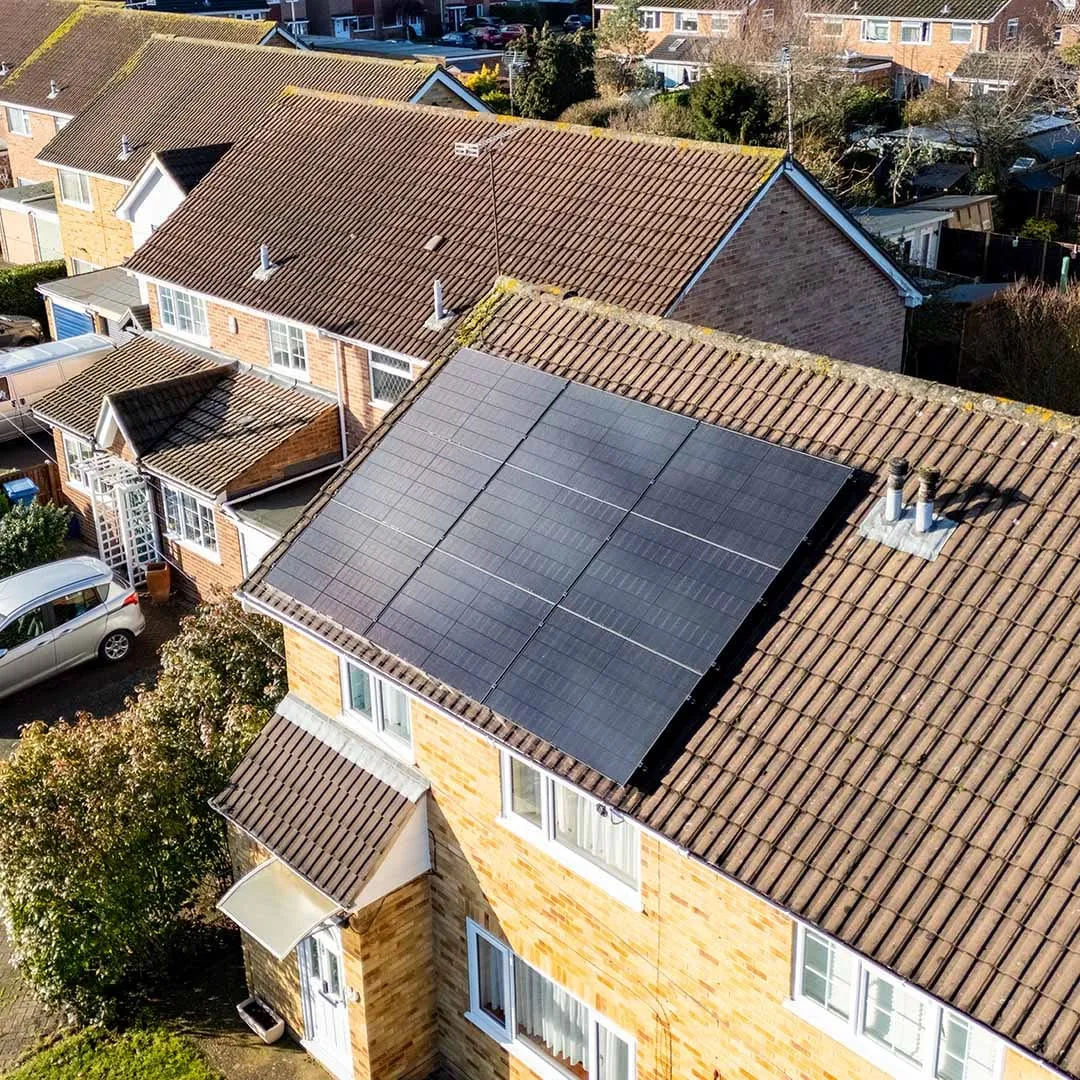
Reading rarely makes the shortlist when people talk about UK solar hotspots — Bristol, Leeds and the M4 corridor tend to hog the headlines. But for anyone tracking commercial rooftop pipeline rather than postcode chatter, the Thames Valley’s biggest town deserves a proper look. A council with a hard 2030 net-zero date, three sizeable business parks stacked with corporate HQs, and a South East solar resource that beats most of the country on paper — that’s a specific, trackable set of demand drivers, not just vague “green growth” talk.
This is a trade read: what’s actually pushing procurement, where the roofs are, and who’s positioned to fit panels on them.
The council target that sets the clock
Reading Borough Council has committed to a 2030 net-zero target for the borough, set out under the Reading 2030 Climate Strategy. That’s a materially tighter deadline than the UK’s national 2050 goal, and it changes the calculus for any organisation operating council-linked contracts, planning applications, or supply-chain relationships in the area. A borough-level target this aggressive typically filters down through three channels installers should watch: council-owned estate retrofit (leading by example, procurement-visible), planning policy leaning harder on embodied and operational carbon for new commercial development, and supplier/tenant pressure where the council’s own net-zero commitments start showing up as expectations on contractors and business-rate payers.
None of that guarantees a grant pot or a fast-track consent process — Reading, like most local authorities, isn’t running a bespoke commercial solar subsidy. But a fixed 2030 date is a genuine forcing function. Organisations with long asset-replacement cycles (roof recover, HVAC replacement, EV fleet rollout) that ignore it now are more likely to be retrofitting solar under time pressure later, at a worse point in the procurement cycle.
The corporate demand signal is already there
What makes Reading different from a lot of provincial towns chasing the same 2030-ish targets is who actually occupies the buildings. The town sits inside the wider Thames Valley technology and data-centre cluster, and it carries a strong corporate presence — SAP, Microsoft and Oracle UK all have a footprint in and around Reading. That matters commercially because global tech tenants arrive with existing group-level sustainability commitments (RE100-style renewable procurement pledges, science-based targets, net-zero-by-a-fixed-year corporate policies) baked in well before any local council strategy asks them to move.
For installers and investors, that’s the more reliable demand signal of the two. A single business park lease renewal with a sustainability clause attached can move faster than years of planning-policy tightening. It also skews the type of project on offer: fewer one-off small commercial roofs, more portfolio-level asks — on-site generation blended with power purchase agreements, battery storage for peak-shaving against corporate energy budgets, and EV charging infrastructure sitting alongside the panels rather than as an afterthought.
Where the roof pipeline actually sits
Three business parks account for most of the addressable commercial roof space serving this demand:
| Estate | Character | Relevance to solar pipeline |
|---|---|---|
| Green Park | Landscaped corporate HQ campus, home to major tech and services occupiers | Large flat-roofed office buildings, strong tenant sustainability mandates |
| Thames Valley Park | Riverside office/business park, established corporate occupiers | Similar office-led roof stock; car parking areas suited to canopy solar |
| Reading International Business Park | Mixed office and light-industrial park | Broader mix of roof types and ownership structures, more fragmented decision-making |
None of these are announced solar developments — this is roof-stock and occupier-profile reasoning, not a live pipeline list — but the pattern is consistent with what tends to convert into commercial solar deals elsewhere: large flat commercial roofs, corporate occupiers with existing sustainability reporting obligations, and car parking areas that suit canopy-mounted arrays as well as roof-mounted ones. That last point is worth flagging for anyone scoping Green Park or Thames Valley Park specifically — solar car park canopies are increasingly the pragmatic answer where roof access is complicated by multi-tenant ownership or listed-style landscaping constraints, and the office-block roof stock itself is exactly the profile covered by specialists in solar for office buildings.
The economics, regionally adjusted
Reading sits in the South East, where solar irradiance is genuinely better than the UK average — closer to 1,000 kWh per kWp per year against a UK-wide figure often quoted around 850 kWh/kWp/yr. That roughly 15-18% yield uplift over less favoured regions matters more at commercial scale, where systems are commonly 30-100+ kWp rather than a domestic 4kW array, so the absolute kWh difference compounds quickly across a payback calculation.
Two other local data points frame the opportunity size. Average commercial energy spend in the Reading area runs to roughly £48,000 a year — a figure that gives installers and finance providers a workable baseline for sizing an on-site generation offer against a real energy bill rather than a national average. And the local housing market (average house price around £380,000) signals the kind of asset values and commercial rents that typically accompany premium business park locations — relevant context for anyone underwriting a rooftop lease or PPA against landlord covenant strength.
On the policy side, it’s worth being precise for a trade audience: the 0% VAT relief on residential solar and battery storage installations in Great Britain (in place until 31 March 2027, before a scheduled return to 5%) applies to domestic installations — it does not extend to standard commercial contracts, which remain VAT-rated in the normal way (generally reclaimable for VAT-registered businesses). Commercial buyers in Reading should be modelling on standard VAT treatment, not assuming the residential relief carries across. On the export side, Smart Export Guarantee rates are supplier-set rather than fixed nationally, with top-end tariffs typically quoted in the 12-20p/kWh range — worth shopping around on for any commercial system with material export volumes, particularly office-led sites with lower weekend/holiday demand than a factory or warehouse.
Financing the pipeline without capex
Given the tenant profile — large corporates with balance-sheet discipline and procurement processes that favour opex over capex — power purchase agreements and asset finance are likely to do more of the heavy lifting in Reading than straight cash purchase. A PPA lets an occupier or landlord host a system funded and owned by a third party, paying only for the power generated at a rate below grid import; asset finance spreads the capital cost against the energy savings instead of requiring it upfront. For anyone structuring a deal around Green Park or Thames Valley Park’s corporate tenant base, that’s a more realistic starting conversation than a straight cost quote, and it’s worth routing procurement teams toward resources built specifically for that structure — commercial solar PPA arrangements and solar asset finance options both address the same underlying problem: getting a system on a corporate roof without it competing against other capital projects for budget.
The installer landscape serving the Thames Valley
Reading’s position on the M4 corridor puts it within reach of several regional commercial specialists rather than any single dominant local player. SOLA UK in the Thames Valley covers the Hertfordshire and wider Home Counties patch that overlaps directly with Reading’s business park cluster, and is a natural fit for organisations wanting a specialist with genuine regional presence rather than a national installer working the area remotely. Further south, Solent Solar brings Hampshire-based commercial delivery capacity that’s realistically within range for larger South East contracts, while Premier Electrical Renewables adds another regional option covering solar, battery and EV charging work — relevant given how often Reading’s corporate-tenant projects bundle those three together rather than treating solar as a standalone install.
For a broader national view of the specialist commercial market covering Reading specifically, commercial solar panels Reading is worth a look, as is the location-specific breakdown at solar for businesses in Reading — both give a useful second data point against the estate-level reasoning above.
The national backdrop
None of Reading’s local dynamics happen in isolation from the wider market. MCS-certified installers completed a record 257,397 installations across the UK in 2025, up 32% year-on-year, taking cumulative MCS-certified deployment to around 21.6 GW — solar now meets roughly 6.4% of UK electricity demand. That’s still overwhelmingly a domestic-market number, but it’s a reasonable proxy for installer capacity and supply-chain confidence feeding into the commercial segment too, where certification (MCS is also the gateway to SEG eligibility) remains the baseline credibility check for any procurement team vetting contractors. For a fuller trade-level breakdown of what’s driving that national growth curve, see our own read on the UK solar industry heading into 2026. On the cost side specifically, the commercial solar panel cost breakdown from our sister site is a solid reference point for benchmarking quotes against current market rates, and for buyers wanting the consumer-facing maintenance angle once a system’s in, solar panel maintenance in the UK covers the basics worth flagging to any commercial client asking what happens after commissioning.
What to watch
Reading’s commercial solar story isn’t about a grant scheme or a headline subsidy — there isn’t one specific to the town. It’s a convergence of a hard council deadline, a tenant base with pre-existing corporate sustainability obligations, better-than-average South East solar yield, and a roof stock concentrated in three identifiable business parks. For installers and investors deciding where to put sales effort in the wider Thames Valley, that combination — policy pressure plus corporate demand plus decent physics — is a more dependable signal than most councils’ climate strategies manage on their own. The pipeline is there; it’s a matter of which regional installers get to the procurement conversations first.