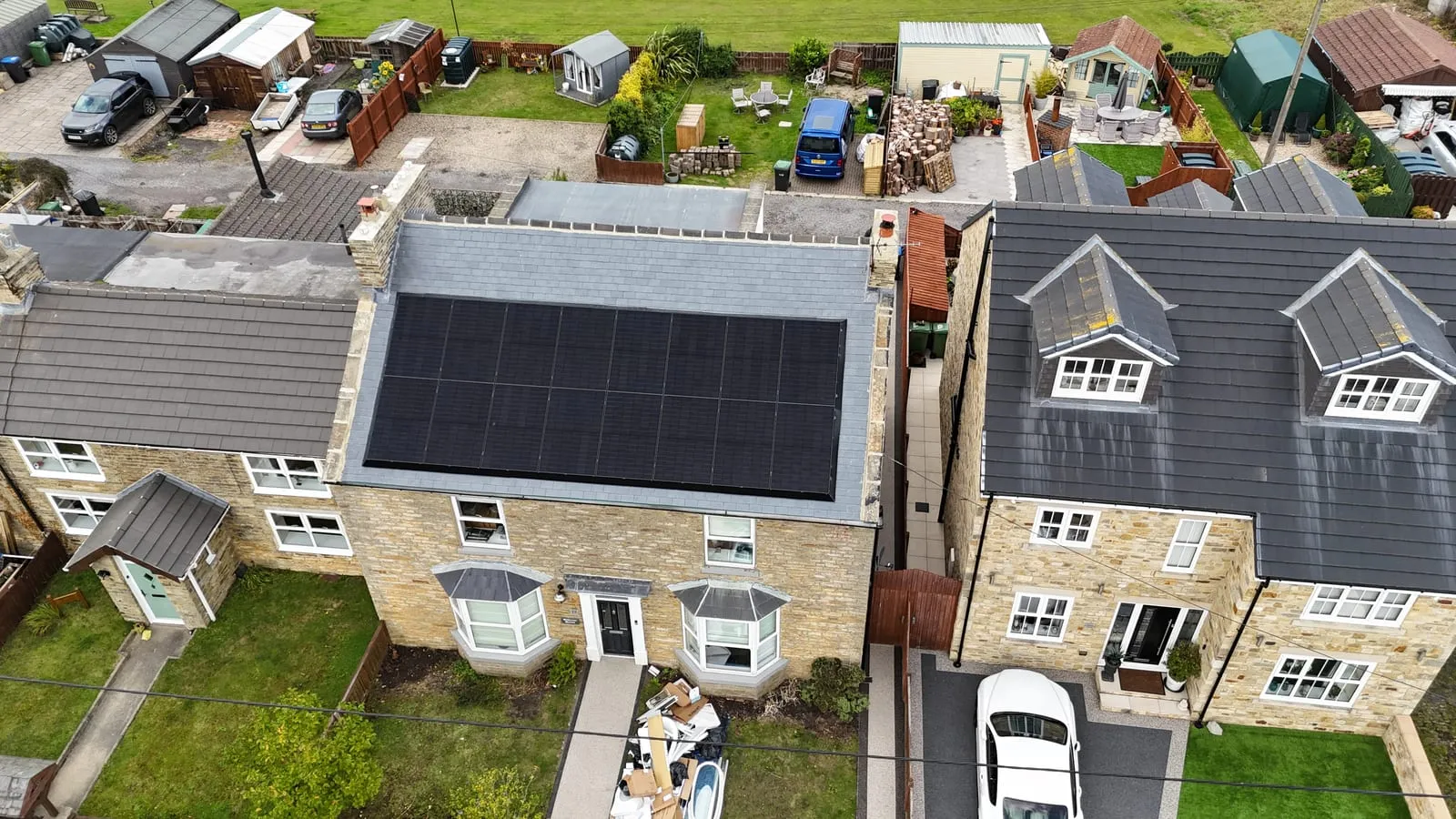
Drive south from the A1(M)/M18 interchange into Doncaster and the geography does most of the talking: mile after mile of grey box-profile roofing, much of it still un-panelled. Doncaster’s economy has been rebuilt around inland logistics and freight over the past fifteen years, and that shift — more than any solar-specific incentive — is what’s now shaping the borough’s commercial solar pipeline. With a population of 311,890 and an average house price of around £165,000, comfortably below the England average, Doncaster’s land and property costs have made it a magnet for the distribution-shed developers who build the roofs that installers eventually climb onto. This is a trade-side look at what’s driving that pipeline, where the roof stock actually sits, and who’s installing on it in 2026.
The policy driver: a 2040 target with no dedicated grant behind it
Doncaster Council has set a net-zero target of 2040 — a decade ahead of the UK’s statutory 2050 date — codified in the Doncaster Climate Strategy. Like most local authority frameworks of this type, its teeth are mostly on the council’s own estate and its planning and procurement conversations with developers and landlords, rather than a direct subsidy pot. There is no dedicated Doncaster or South Yorkshire solar grant for commercial occupiers, and it’s worth being precise about the wider picture too: the 0% VAT rate on solar and battery storage (in place in Great Britain until 31 March 2027) applies to residential installs, not commercial ones, so it plays no part in the borough’s warehouse and factory economics.
For a commercial or industrial landlord in Doncaster, the practical levers are capital allowances — full expensing and the Annual Investment Allowance let companies deduct qualifying solar plant against taxable profit in the year of spend — plus steadily falling installed costs and import electricity prices that show no sign of returning to pre-2021 levels. That combination, not a grant cheque, is what’s converting the council’s climate ambition into actual roof deals.
Where the pipeline actually sits
Three places do most of the talking when you map Doncaster’s commercial roof opportunity.
iPort Doncaster is the headline site. It’s one of the UK’s largest inland logistics hubs, sitting directly on the M18/A1 corridor, and its scale is the reason this market is worth a trade write-up at all: the distribution sheds built for occupiers there run to hundreds of thousands of square feet of unshaded, structurally simple flat roof — about as close to ideal solar real estate as commercial buildings get. The car parking and HGV yards across the site are also generating interest, since solar for businesses in Doncaster increasingly means canopy structures as much as roof-mount, and solar carport and canopy schemes are starting to appear on logistics-park masterplans elsewhere in the UK — worth watching for a site of iPort’s footprint.
DN7 Inland Port, immediately adjacent, extends the same corridor logic — more large-format distribution and freight-handling roof stock feeding off the same M18/A1 connectivity that makes this part of South Yorkshire attractive to occupiers who want good self-generation economics alongside good transport links. Anyone scoping a distribution centre roof programme in this pocket of Yorkshire is, in practice, looking at the same handful of sites iPort and DN7 between them cover.
Wheatley Hall Industrial Estate, closer to Doncaster town centre, is a different roof type entirely: smaller, older, mixed light-industrial and manufacturing units rather than big-box logistics sheds. It’s a useful reminder that Doncaster’s commercial solar market isn’t only about mega-sheds — a lot of the borough’s roof stock is exactly the kind of mid-size unit that industrial estate solar programmes are built around, often with shorter payback windows because the systems are smaller and quicker to install without disrupting tenants mid-lease.
The numbers: what Doncaster’s commercial roof economics look like
| Metric | Doncaster / regional figure |
|---|---|
| Average commercial energy spend | ~£36,000/yr |
| Region | Yorkshire and the Humber |
| Typical solar yield | ~860 kWh/kWp/yr |
| Commercial installed cost | ~£900–£1,200/kWp |
| Typical import price | ~25p/kWh (Ofgem cap, variable by tariff) |
| SEG export rate (top suppliers) | ~12–20p/kWh, varies by supplier |
Put those figures together and the shape of the opportunity is clear. A mid-size Wheatley Hall unit or a slice of an iPort distribution shed spending in the region of £36,000 a year on grid electricity is sitting on a cost base that a well-specified rooftop array can meaningfully dent, even before accounting for on-site consumption offsetting a roughly 25p/kWh import price most commercial tariffs are still tracking. Yorkshire and the Humber’s yield of around 860 kWh per installed kWp a year is respectable rather than exceptional — well behind the sunnier south coast, but perfectly workable at commercial system sizes where the economics are driven far more by self-consumption than by export. Smart Export Guarantee income is a secondary benefit for most commercial sites rather than the main case, since supplier rates vary widely and daytime industrial or logistics loads tend to consume most of what’s generated on-site anyway.
Finance and procurement
For occupiers and landlords weighing up a commercial solar Doncaster instal against other capital priorities, the finance conversation has moved well past straight cash purchase. Power purchase agreements, where a third party funds and owns the array and the site host simply buys the generated electricity at a discount to grid rates, are increasingly how larger multi-tenant logistics sheds get solar onto the roof without capital outlay — a model solar power purchase agreement providers are actively writing for sites at iPort’s scale. Asset finance and leasing, tracked by specialists like solarassetfinance.co.uk, sit alongside PPAs for landlords who’d rather own the asset outright but spread the cost over its working life. For anyone modelling a specific roof before commissioning a full survey, a business solar ROI calculator is a reasonable first pass at payback before a formal quote lands.
Commercial-specific lenders and brokers — see commercial solar finance options — are increasingly comfortable underwriting against a logistics tenant’s covenant strength rather than treating solar as a bolt-on to a wider fit-out, which matters on a corridor where several of the largest occupiers are household-name logistics operators on long leases.
There’s a second policy driver working alongside the council’s climate target that’s easy to miss: Minimum Energy Efficiency Standards for commercial lets. Landlords letting sub-standard buildings face increasing scrutiny on Energy Performance Certificate ratings, and a rooftop array is one of the more straightforward ways to move a mixed-use unit at Wheatley Hall, or a distribution shed at iPort, towards a better EPC band without a full fabric retrofit. For borough landlords weighing this up alongside net-zero pressure from occupiers with their own sustainability commitments, landlord EPC and MEES compliance guidance and a proper commercial EPC assessment are usually the right starting point before specifying a system, since the assessment shapes what “good enough” looks like for that specific building.
The installer landscape
Doncaster’s own installer base is a genuine asset here, not just a footnote. ElectriFusion Solutions in Doncaster covers solar and general electrical work across Doncaster and South Yorkshire, giving the borough a locally based, MCS-route option rather than relying entirely on installers travelling in from Sheffield or Leeds. AMP Pro Electrical, also based in Doncaster, works the same electrician-plus-renewables model — useful for occupiers who want one contractor handling both the electrical infrastructure upgrade a large rooftop array often needs and the panel install itself. For procurement teams scoping multiple quotes before going to tender, commercial solar panels Doncaster is a useful starting hub for mapping who’s active across the borough.
That local capacity matters because national installer numbers have grown fast: MCS recorded 257,397 UK solar installations in 2025, up 32% year on year, taking cumulative deployed capacity to roughly 21.6 GW and around 6.4% of UK electricity generation. Doncaster’s own installer base has grown alongside that national curve, and MCS certification remains the baseline requirement for any commercial site that wants Smart Export Guarantee eligibility, so it’s worth confirming before commissioning anyone locally.
The other piece trade coverage tends to underweight is operations and maintenance. A 25–30-year panel warranty is only as good as the monitoring behind it, and multi-roof logistics landlords running several sheds across the iPort/DN7 corridor are increasingly looking at dedicated O&M contracts rather than leaving performance monitoring to whoever did the install — a gap solarmaintenancesolutions.com is positioned to fill as a national O&M specialist rather than a regional installer diversifying sideways.
Where to go for more depth
For anyone benchmarking these Doncaster numbers against the wider market, our sister sites carry the underlying data: commercial solar panel costs breaks down the per-kWp figures behind the table above, and solar panel maintenance covers the O&M point in more consumer-facing detail. And if you want the national installer and market-growth context behind the MCS figures quoted here, that’s covered in our own UK solar industry 2026 data round-up.
What to watch next
A few things worth tracking through the rest of 2026: whether Doncaster Council’s Climate Strategy hardens into planning conditions requiring rooftop solar on new distribution-shed consents along the M18/A1 corridor, as a handful of other UK authorities have started doing for new-build logistics sheds; whether iPort’s scale starts attracting third-party PPA providers directly, rather than occupiers negotiating asset purchase individually; and whether Wheatley Hall-type smaller industrial estates see faster uptake now that commercial system costs have fallen enough to make sub-£15,000 arrays viable for single-tenant units. None of this needs a new subsidy to happen — it needs procurement teams and landlords to run the numbers on assets they already own.
For installers and investors watching this corridor, the read is straightforward. Doncaster’s commercial solar opportunity is being built by logistics-sector roof stock and a council net-zero target with real planning leverage, not by a grant scheme that doesn’t exist. The roofs at iPort, DN7 and Wheatley Hall are there now; the finance models to fund them without capital outlay are maturing; and the local installer base — from ElectriFusion Solutions to AMP Pro Electrical — already carries the MCS accreditation to deliver at scale. The next twelve months are about procurement catching up with the roof stock, not about waiting on Westminster.