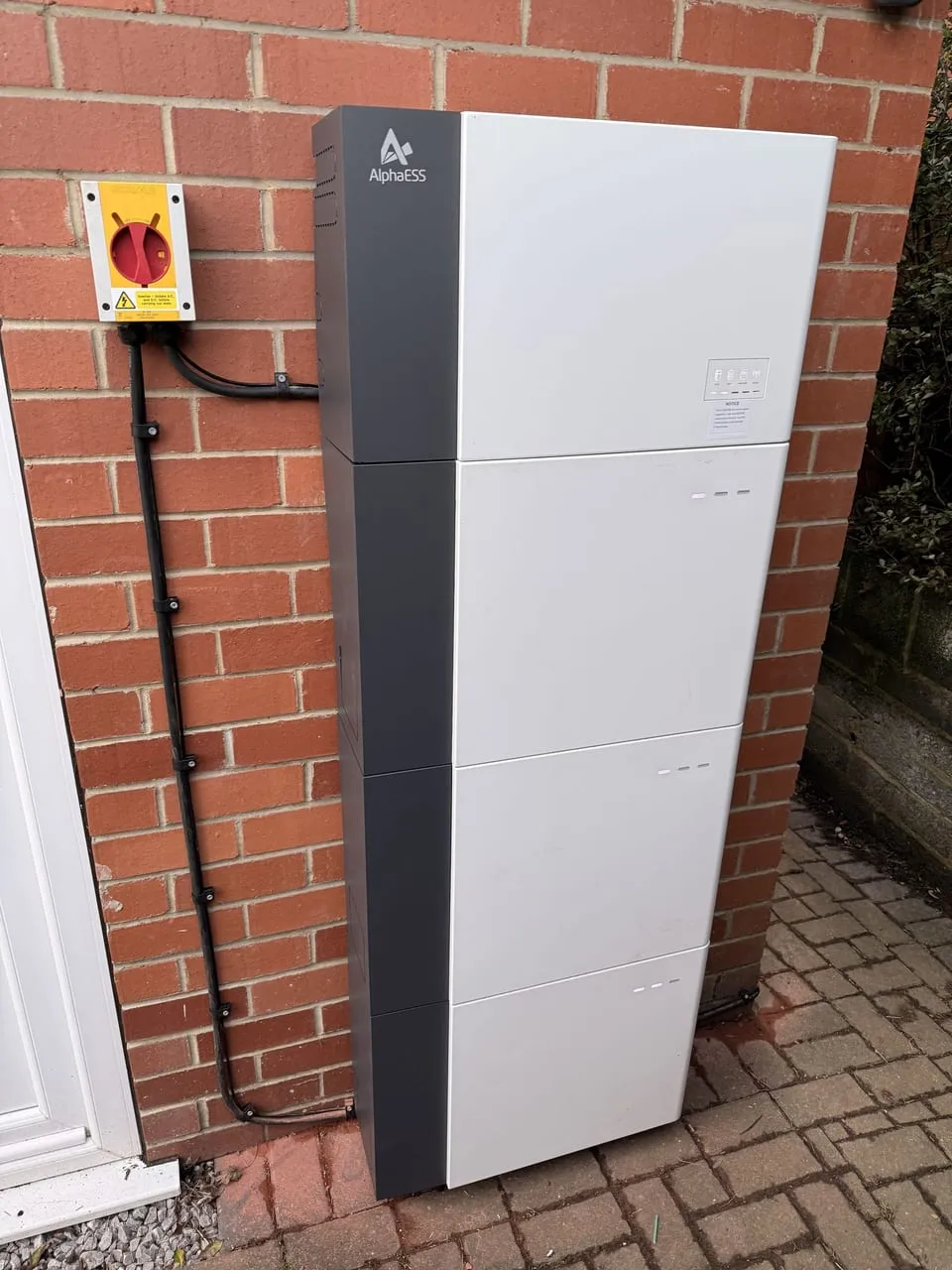
The UK’s residential solar boom has quietly become an inverter story. Behind the 257,397 MCS-certified installs of 2025, the equipment doing the interesting work — deciding whether a household exports, stores, arbitrages against a tariff, or bricks itself after year eight — is the inverter, and the market underneath it has shifted more in the last eighteen months than in the previous five years combined.
From string boxes to hybrid brains
Five years ago, “inverter” meant a wall-mounted box that turned DC into AC and sent the surplus to the grid for whatever the supplier offered that quarter. That market still exists — plenty of straightforward grid-tie systems go in every week — but the growth, and increasingly the margin, is in hybrid inverters: units built from day one to manage a battery, talk to a home energy management system, and switch loads around a time-of-use tariff without an installer touching it again.
The driver isn’t subtle. With 0% VAT on residential solar and battery storage running in Great Britain until 31 March 2027, a battery retrofit or day-one battery attach is now the cheapest it will be for the foreseeable future, and installers report attach rates climbing accordingly. A hybrid inverter is the only sensible spec for that job — running a separate AC-coupled retrofit battery alongside an ageing string inverter is still common, but it’s increasingly the fallback option rather than the design intent. Anyone speccing a new system in 2026 without at least considering hybrid topology is leaving flexibility, and probably margin, on the table.
The economics reinforce the shift. Import electricity sitting around 25p/kWh against export rates that top out somewhere in the 12–20p/kWh range for the best Smart Export Guarantee tariffs (SEG rates are set by individual suppliers, not government, and vary significantly) means self-consumption is worth roughly double what export is worth, kWh for kWh. A hybrid inverter that can shift generation into storage rather than the grid is doing real, quantifiable work for the customer — which is a much easier sell than “you’ll get a slightly better export rate,” and it’s why installers who’ve built battery-attach into their standard quote are seeing better close rates than those still pitching solar-only.
The brand landscape: consolidation at the top, fragmentation underneath
Four names dominate installer conversation in 2026, for different reasons.
SolarEdge remains the default reference point for optimiser-based DC architecture — module-level optimisers plus a central inverter — which still wins on shading-heavy roofs and on the “every panel reports individually” monitoring pitch that’s easy to demonstrate to a homeowner standing in their driveway. It’s a mature, well-understood ecosystem, and its enterprise/commercial range keeps it relevant on C&I jobs too, not just domestic retrofits.
GivEnergy built its UK domestic hybrid share on price, stock availability through UK distribution, and an increasingly capable app/EMS layer — its all-in-one battery-inverter cabinets became a default spec for a huge slice of the 2023–2025 battery-attach wave. That said, installers should treat any single-brand dependency as a business risk, not just a product choice: distributor and manufacturer positions change, and a spec locked to one supply chain is a spec exposed to that supply chain’s problems.
Fox ESS has pushed hard on the hybrid-plus-EV-charger-plus-battery “one ecosystem” pitch, with strong price-to-spec numbers that appeal to installers competing on total system cost rather than brand premium — a sensible strategy in a market where the customer increasingly shops on a blended quote rather than a component list.
Sunsynk has carved out a position on flexibility and off-grid/backup capability, appealing to installers whose customers want genuine outage resilience rather than just export optimisation — a distinct enough use case that it doesn’t compete head-on with the others so much as serve a different buying trigger.
Below those four sits a longer tail — Growatt, Huawei, Solis, Deye and others — competing largely on landed cost and distributor relationships rather than brand pull. For an installer, the practical takeaway isn’t “which brand wins” but “which two or three brands can you service properly, with parts and firmware support, five years from now” — because the next wave of demand isn’t new installs. It’s replacements.
The replacement wave nobody’s pricing in yet
String inverters typically last 10–15 years; the first serious wave of UK domestic solar (the 2010–2012 Feed-in Tariff boom) is now well past that window, and the second wave — the post-2019 export-only cohort — starts hitting end-of-life through the late 2020s. Replacement cost sits at roughly £500–£1,000 for a like-for-like swap, but the real commercial opportunity is the upsell: a customer calling about a failed 10-year-old string inverter is a customer who can be walked into a hybrid unit and a battery in the same visit, often at a materially better margin than a cold-lead new-build quote.
That’s a genuinely underexploited pipeline. Most installer marketing still chases new-build solar leads while a growing base of existing owners are sitting on ageing kit that will fail on a predictable schedule. Installers who build a proactive “your system is coming up on inverter age” outreach — even something as simple as a postcode-mapped list of installs from 10+ years ago — are fishing in water competitors haven’t found yet. It’s also a natural bridge into modern panel technology: N-type TOPCon, HJT and ABC cells now degrading at around 0.4%/year and rated for 25–30+ years mean a replacement job is rarely “swap the inverter,” it’s “is it worth re-panelling at the same time,” which is a bigger, better conversation for both installer and customer.
For installers building out this side of the business, Yorkshire-based YEERS has been running solar, battery, heat pump and EV work under one roof for a while and is a useful reference point for how a multi-service installer structures that conversation. On the South Wales side, FLD Electrical in Swansea combines the electrical-contractor background that makes inverter and consumer-unit replacement work straightforward with the solar install itself — exactly the dual-trade setup this replacement wave rewards.
What this means for spec sheets and quotes
For installers writing quotes in 2026, a few practical implications fall out of the above:
- Default to hybrid unless there’s a specific reason not to. With 0% VAT still running and battery costs at roughly £400–£700/kWh installed (a 13.5kWh Tesla Powerwall 3 lands around £8,500–£10,500, more modest hybrid-paired batteries considerably less), the cost delta for hybrid-ready wiring at install time is small next to the cost of a retrofit AC-coupled system later.
- Diversify inverter brand exposure across your supply chain, not because any one brand is unreliable, but because distributor and stock positions shift faster than a five-year warranty period.
- Build inverter-age tracking into your CRM now. A dated list of your own historic installs is the cheapest lead-generation asset you’ll build all year.
- Don’t oversell SEG. Quoting a single national export rate when the real range is supplier-dependent and moves regularly is the fastest way to lose trust when the customer’s first bill doesn’t match the pitch.
Installers wanting a second opinion on where hybrid demand is strongest regionally can look at how Ecoaim in Livingston has built out its Central Scotland battery-and-solar offer, or how Premier Electrical Renewables packages solar, battery and EV charging as one regional spec — both useful live examples of hybrid-first quoting in practice rather than theory.
On the commercial side, the inverter conversation is a different shape entirely — three-phase, higher DC input, and generally a longer replacement cycle — but the same “hybrid by default” logic is increasingly the norm there too. Solar Panels for Warehouses and Solar Panels for Factories both cover the C&I inverter-and-battery-storage sizing questions in more depth than this piece can, for installers pricing jobs where import offset against a half-hourly commercial tariff (rather than a domestic time-of-use rate) is the driver. And for the finance side of a commercial hybrid spec — where inverter and battery cost gets folded into a wider asset — Commercial Solar Finance is worth a look at how those numbers get structured for a business customer.
The data gap
What’s still missing from the UK conversation is a properly sourced, regularly updated market-share breakdown by inverter brand and topology — the kind of number every installer asks for informally and nobody publishes for free. Until that exists at scale, the practical read for anyone speccing systems in 2026 is this: hybrid is no longer the premium option, it’s the rational default; brand loyalty is a supply-chain risk to manage rather than a marketing decision to make once; and the next twelve months of lead generation belong as much to your own install base ageing out of warranty as to any new-build pipeline. For the cost side of that conversation — what a hybrid system with battery actually costs a homeowner in 2026 — our sister site has the breakdown by system size, and if you’re building the customer-facing case for why battery storage pays back faster than export-only, the payback period modelling is a useful reference to point customers at directly.
Installers reviewing their own lead-generation numbers against the wider market should also see our companion piece on installer marketing benchmarks — the inverter shift above is, in the end, a spec question; what converts it into booked jobs is still a marketing and trust question, and that’s the lane this site exists to cover.