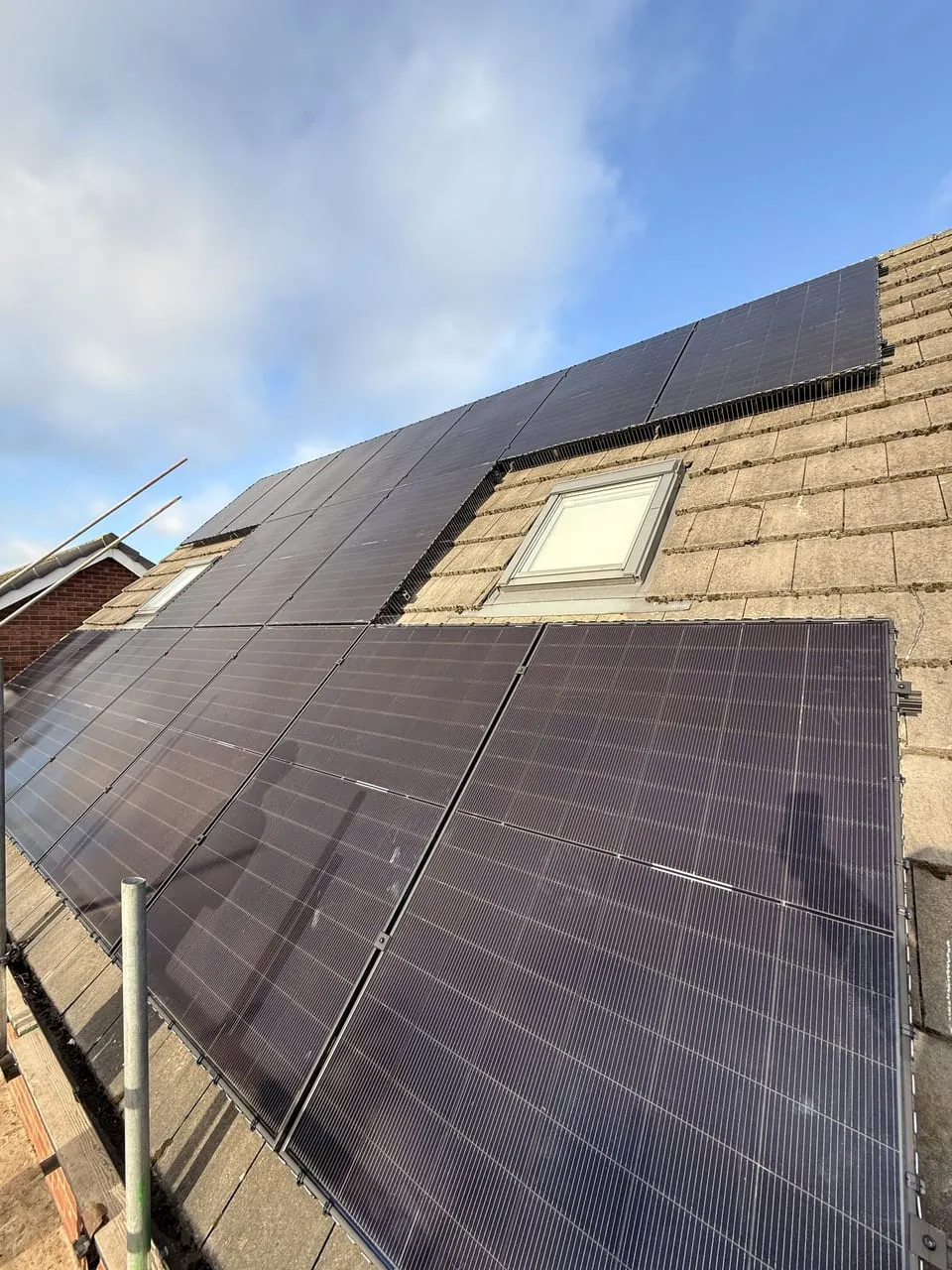
Fuse-based export limitation used to be the reason installers walked away from a quote. Today it’s often the reason they win one. With DNO connection queues stretching for months on unconstrained applications in parts of the country, the ability to offer a zero-export or partial-export design — sized to the customer’s actual roof and actual load, not to whatever a 60A or 100A fuse “allows” — is turning into a genuine commercial differentiator. This piece is for installers and their commercial teams: what export limitation actually is, how DNOs assess it, and — the bit most technical guides skip — how to explain it to a customer without the conversation collapsing into “so I’m being restricted, why would I pay for a bigger system?”
What export limitation actually means
Every property has a fuse rating at the cut-out — commonly 60A or 80A single-phase domestically, up to 100A or beyond, and various three-phase ratings for commercial supplies. G98/G99 (the DNO connection standards for small and larger generators respectively) size the maximum permitted export against that fuse and the local network’s headroom, not against the size of the array on the roof.
Historically, a large system on a small fuse simply couldn’t get an unrestricted export approval — DNOs would either reject the application, demand costly reinforcement work, or force a reduced inverter export setting. Export limitation turns that constraint into a design choice rather than a dead end:
- Zero export — the inverter (or a separate export limitation device, ELD) is configured to never push power onto the grid, full stop. Common on commercial rooftops where the DNO connection is contested or the site simply self-consumes almost everything it generates anyway.
- Partial/soft export limitation — a monitored cap, e.g. “export no more than 16A” or “no more than 3.68kW,” enforced dynamically by the inverter or an external controller reading a CT clamp at the grid connection point.
- Hard export limitation — a certified, fail-safe device (rather than just an inverter software setting) that a DNO will accept as a guarantee against the connection agreement, typically required above a certain system size or on more sensitive parts of the network.
The commercial logic is simple: a customer with a 60A single-phase fuse might only get 3.68kW (16A) of unrestricted export approved under G98 without deeper network studies. But if that customer’s actual daytime demand — a care home’s laundry, a cold store’s compressors, an office’s HVAC — comfortably absorbs 15-20kWp of generation before anything would even reach the fuse, then export limitation lets you size the system to the load, cap what leaves the site, and get a straightforward DNO acceptance instead of a stalled or rejected application.
Reading the DNO’s actual position
This is where installers who only quote residential jobs tend to get caught out on commercial work. G98 covers small-scale embedded generation (broadly up to 16A per phase, so around 3.68kW single-phase or roughly 11kW three-phase) and is largely a notification process. G99 covers everything above that and is a formal application — the DNO can request an impact study, ask for network reinforcement contributions, or impose export limits as a condition of connection.
Three things worth knowing before you quote:
- Export limitation is often the DNO’s preferred outcome, not a concession. A network operator managing constrained substation capacity in a given postcode would frequently rather approve a zero-export commercial array today than tie up capacity assessing an unrestricted one that might take months. If you can lead with “we’ll zero-export as standard, no network impact,” you’re often removing the single biggest source of delay in the whole project.
- The device matters, not just the setting. Some DNOs will accept an inverter’s built-in export control as sufficient for smaller schemes; others — especially on larger commercial systems or weaker parts of the network — will only accept a certified, independently fail-safe ELD wired in front of the inverter. Confirm this per-DNO and per-scheme size before you spec hardware, not after the application is submitted.
- MCS still applies. Export limitation doesn’t remove the need for MCS certification if the customer wants Smart Export Guarantee eligibility down the line, or SEG payments on whatever export is permitted. It’s entirely possible — and common — to run a zero-export commercial system with no SEG income at all; that’s a legitimate design outcome, not a failure, provided the customer understood that trade-off before signing.
For installers taking on more complex applications, SolarMaintenanceSolutions.com covers ongoing monitoring and export-limitation device servicing nationally, which is worth flagging to clients who ask “who checks this thing still works in three years.”
Sizing bigger behind a small fuse: the actual arithmetic
The commercial pitch to a business customer isn’t “you can have a bigger system despite your fuse” — it’s “your fuse rating is irrelevant to how much you can self-consume, so let’s size to your demand.” A rough worked example:
A single-storey warehouse with a 100A three-phase supply might, under an unrestricted G99 application, be capped hard by DNO headroom in a busy area. But if the site runs cold storage or 24-hour conveyor/pick-pack operations with a baseline demand of 40-60kW through the working day, a zero-export 80-100kWp array (at commercial costs of roughly £900-£1,200 per kWp installed) can be justified almost entirely on self-consumption economics — no export income assumed, no DNO capacity argument to win, because nothing leaves the site. The payback case is built entirely on displaced import at typical commercial rates, which is a far cleaner story to put in front of a finance director than one leaning on a variable SEG rate.
This is precisely the sizing logic covered in more depth on SolarPanelsForWarehouses.co.uk and SolarPanelsForColdStorage.co.uk — both sectors where daytime baseload is high enough that zero-export designs routinely outperform unrestricted-but-delayed alternatives on time-to-energised-system alone. The same logic extends to SolarPanelsForDistributionCentres.co.uk, where near-continuous conveyor and refrigeration loads make a strong case for going bigger behind a modest connection.
Where the site doesn’t have that baseload — a seasonal office, a school with long summer closures — export limitation becomes a constraint rather than an enabler, and the honest advice is to size closer to average consumption and accept a smaller roof coverage. Overselling capacity a site can’t use, purely because “the fuse allows it with limitation,” is how commercial solar gets a bad name with finance directors who did the sums after the event.
Customer communication: where most of these deals actually get lost or won
Technically correct export limitation designs fail commercially all the time because nobody explained the concept in language the customer’s decision-maker actually uses. A few patterns worth building into the sales process:
Lead with the delay avoided, not the restriction imposed. Framing “we’re limiting your export to zero” as a downgrade invites objection. Framing it as “this design gets you connected in weeks instead of joining a network reinforcement queue that’s currently running 12-18 months in your area” reframes the same technical fact as the reason the project is deliverable at all. DNO queue times vary significantly by region and are worth checking directly with the relevant network operator for the specific site — don’t quote a generic national figure as if it’s universal.
Separate “can I export” from “should I export.” Many commercial customers assume more panels automatically means more income via SEG. For a zero-export system that’s simply false, and needs saying plainly before contracts are signed, not discovered by the customer’s accountant afterwards. SEG rates also vary considerably by supplier — commonly ranging up to somewhere around 12-20p/kWh at the better end — so where partial export is permitted, avoid quoting a single fixed rate as guaranteed.
Show the self-consumption number, not just the generation number. A customer with a large zero-export array cares about kWh displaced from their bill, not kWp on the roof. Tie the proposal to their actual half-hourly consumption data (increasingly available from smart meters) rather than a generic assumption, and the export limitation stops looking like a compromise and starts looking like precision engineering.
Battery storage changes the maths again. Pairing a capped-export or zero-export array with commercial battery storage lets a site bank generation that would otherwise be curtailed at peak solar output but unused on-site at that moment, and discharge it later rather than losing it. This is well worth raising with sites that have a lumpy demand profile — heavy in the morning and evening, lighter at midday — where without storage a chunk of the array’s midday output would otherwise have nowhere to go. BatteryStorageForBusiness.co.uk sets out the sizing logic for that pairing in more detail, and it’s a natural upsell conversation once the export-limitation design is already on the table.
For finance-led conversations — particularly where a customer is trying to decide whether a larger, self-consumption-optimised zero-export system stacks up against a smaller unrestricted one — CommercialSolarFinance.co.uk and SolarAssetFinance.co.uk both cover funding structures that work whether or not SEG income forms part of the payback case, which matters because a zero-export design should never lean on export revenue in its financial model.
Installer-side checklist
Before quoting a system that will need export limitation, confirm:
| Check | Why it matters |
|---|---|
| Fuse rating and phase (single/three) at the connection point | Determines whether the job is G98 or G99, and the unrestricted export ceiling |
| DNO’s stated position on ELDs vs inverter-only limitation for this scheme size | Some networks won’t accept software-only limiting above a threshold |
| Site’s actual daytime baseload (ideally half-hourly data) | The real ceiling on how big a zero-export design can sensibly go |
| Whether the customer needs/wants SEG eligibility at all | Changes whether zero-export is acceptable or partial export is required |
| Regional DNO queue times for unrestricted vs limited applications | The commercial argument for limitation often rests entirely on this delta |
Practical, installer-facing detail on both fuse ratings and the connection process is also covered from the customer side on Solar Panels For Industrial Units and Solar Panels For Logistics, useful if you’re pointing a prospect toward background reading before a site survey. On the domestic-adjacent end of the market, installers such as Ecoaim in Central Scotland and Greenlinc Renewables in Lincolnshire regularly handle smaller commercial and mixed-use sites where a G98 export cap is the difference between a straightforward notification and a stalled application — worth a call if you’re benchmarking how regional DNOs (SP Energy Networks and National Grid Electricity Distribution respectively) are currently treating limitation requests in those areas.
For the underlying cost assumptions used in the sizing example above, TheCostOfSolar.co.uk’s commercial solar panel costs page has current per-kWp ranges, and our own UK solar industry 2026 data page tracks how MCS commercial install volumes are trending as more of this capacity goes in behind constrained connections rather than waiting for reinforcement.
The bottom line for the trade
Export limitation isn’t a technical compromise to be apologised for — it’s increasingly the fastest legitimate route to an energised system on a constrained network, and it lets you size to a commercial customer’s real consumption rather than an arbitrary fuse ceiling. The installers winning this work aren’t the ones with the cheapest per-kWp price; they’re the ones who can walk into a DNO application already knowing which limitation approach that specific network operator will accept, and walk into the boardroom already able to explain, in the FD’s terms, why zero export on a bigger system beats a smaller unrestricted one that’s still in a connection queue eighteen months from now.