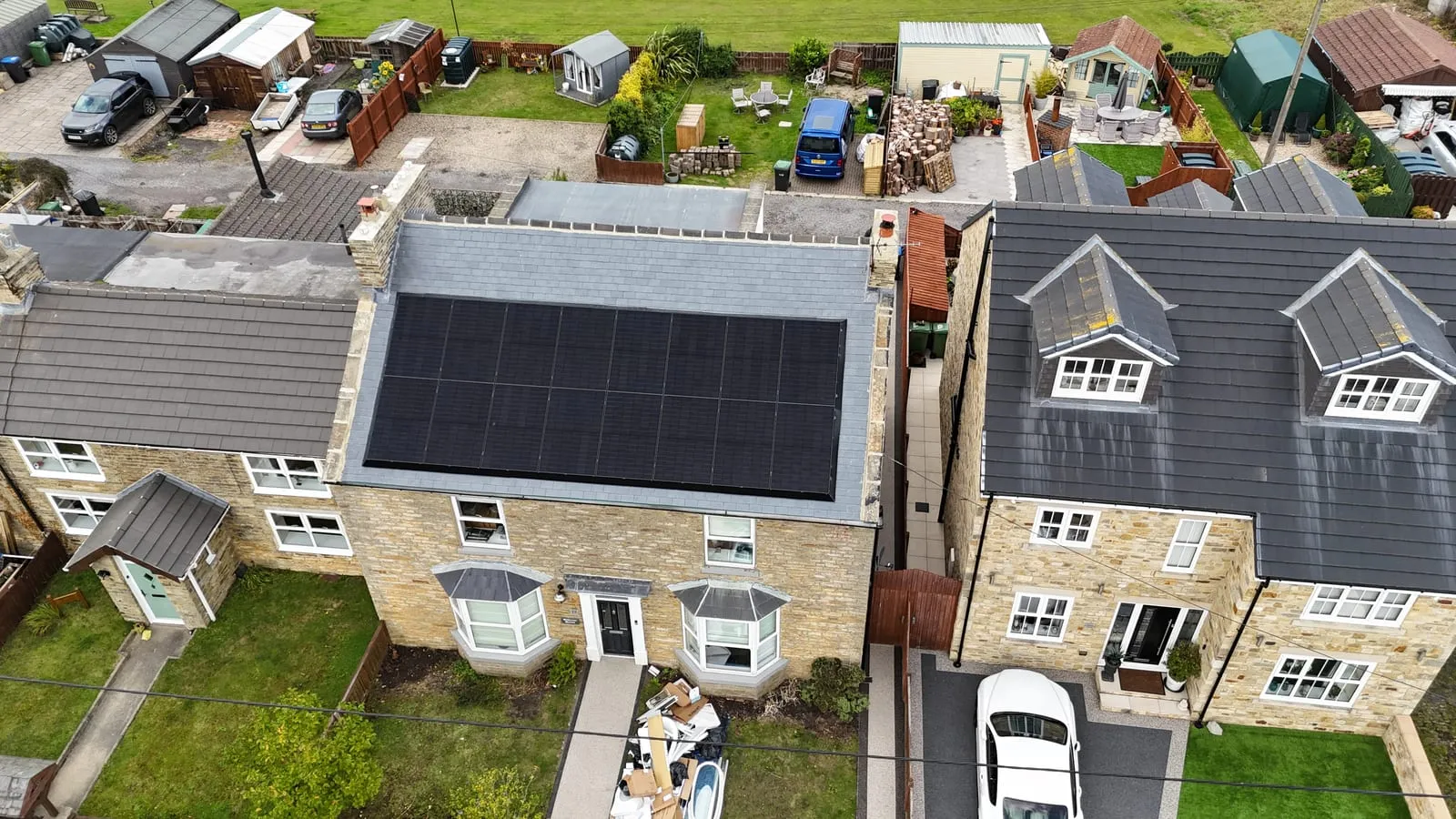
The UK solar trade closes the first half of 2026 with a genuinely unusual set of tailwinds: a record deployment year just banked, a VAT holiday with a hard expiry date bearing down, and a policy landscape that’s shifted meaningfully for both domestic and commercial installers. This is a working roundup of what actually changed — not press-release paraphrasing — with the numbers sourced and the implications spelled out for order books, not just headlines.
The record year, in context
MCS logged 257,397 certified installs in 2025, up 32% year-on-year, taking cumulative deployment to roughly 21.6 GW and pushing solar’s share of UK electricity generation to around 6.4%. That’s the headline the trade press ran with, and it’s real — but the shape of the growth matters more than the topline. Domestic retrofit drove most of the volume increase, and the two structural reasons are well understood in the trade: the 0% VAT rate on residential solar and battery storage in Great Britain, running until 31 March 2027 (scheduled to revert to 5% after that date, on current legislation), and a battery-attachment rate that kept climbing as households chased better self-consumption economics against ~25p/kWh import tariffs under the Ofgem price cap.
For installers, the practical read is this: 2026 and early 2027 is a pull-forward window, not a permanent baseline. Anyone selling on the VAT saving needs a clear, honest script for what happens after March 2027 — a 5% VAT increase on a typical £6,000–£8,000 4kW system is a few hundred pounds, not a reason to panic-buy, but it is a reason some fence-sitting customers convert now rather than in Q2 2027. Firms with disciplined pipeline management (rather than a flat “buy now” push) are the ones reporting the cleanest year-on-year growth — a theme covered in more depth on Solar Weekly’s installer marketing playbook, which benchmarks how UK installers are actually converting this urgency without resorting to pressure-selling tactics that invite complaints.
Policy: what actually moved, and what didn’t
A few things got garbled in consumer-facing coverage this year, so it’s worth being precise for trade purposes:
- No universal England-wide home solar grant exists. ECO4 and the Warm Homes retrofit support remain means-tested, targeted at low-income households in lower-EPC-band properties — not a general solar subsidy. Installers quoting outside that eligibility band should not be implying grant support exists where it doesn’t.
- The Boiler Upgrade Scheme (£7,500) is for air source and ground source heat pumps — it does not fund solar PV. This confusion still shows up in enquiry calls; it’s worth a standard line in the sales script to head it off before it becomes a mid-quote objection.
- Farm and agricultural solar in England sits under the Improving Farm Productivity grant, funding roughly 25% of eligible costs — not the older FETF 40% figure that still circulates in some outdated blog content and even a few installer sites. Rates differ by devolved nation, so anyone quoting a percentage needs to check which grant scheme applies before it goes in writing.
- The Smart Export Guarantee remains supplier-set, not a fixed national rate. Top-end export tariffs sit around 12–20p/kWh depending on supplier and tariff structure, and MCS certification remains the eligibility gate. Quoting a flat “you’ll get X per kWh” figure without checking the customer’s actual supplier options is still one of the more common ways a quote gets challenged after installation.
None of this is new to anyone who reads the policy pages closely, but the drift between what’s technically true and what’s repeated in marketing copy has widened this year — worth an internal audit if your own site or sales materials haven’t been checked against source since last year’s scheme changes.
Tariffs, components and the pricing picture
On hardware: 2026 installed pricing has stayed broadly stable rather than falling sharply, with a typical 4kW residential system running £6,000–£8,000 fitted, a 3kW system nearer £5,000, and 10kW commercial-leaning residential installs in the £13,000–£17,000 range. Commercial rooftop remains quoted per kWp, typically £900–£1,200/kWp depending on scale and roof condition. Battery storage continues to be the bigger swing factor in overall project value — expect £4,000–£8,000 installed for a typical domestic battery (roughly £400–£700/kWh), with premium units like the Tesla Powerwall 3 (13.5kWh) sitting around £8,500–£10,500 installed. For a full breakdown by system size and region, thecostofsolar’s battery storage cost guide is a useful reference point to send customers who want the underlying numbers rather than a single headline quote.
On the technology side, the shift to N-type cells — TOPCon, heterojunction (HJT) and back-contact (ABC) architectures — is now essentially the default for anything mid-tier or above, with manufacturers routinely quoting degradation around 0.4% a year and warranted lifespans of 25–30+ years. That’s a meaningfully better spec than the P-type PERC panels that dominated five years ago, and it’s shifting how payback calculations get framed — total lifetime yield now realistically extends well past a 25-year horizon rather than tailing off. Inverters remain the component that ages fastest in a system: string inverters still typically need replacing after 10–15 years at a cost of roughly £500–£1,000, a maintenance-budget line that’s still under-communicated at point of sale on a meaningful share of domestic installs.
Component tariff and supply-chain dynamics stayed a live issue through 2026 rather than settling — module pricing has been sensitive to shifts in global manufacturing capacity and trade measures affecting cell and wafer imports, and installers sourcing from a narrower panel of Tier 1 suppliers report steadier lead times than those chasing the cheapest spot-price batch. This is a trend worth watching into H2, particularly for commercial-scale procurement where a delayed shipment has a much bigger knock-on cost than on a domestic job.
Commercial and C&I: the underserved growth story
The residential VAT and battery-attachment story has dominated coverage, but the commercial and industrial segment has arguably had the more interesting year. Rising daytime commercial electricity costs, coupled with continued Annual Investment Allowance eligibility on qualifying solar spend, have kept payback periods attractive for warehouse, factory and office-roof installs even without the residential VAT relief (commercial installs were never in scope for the 0% rate in the same way). Firms specialising in this segment — from ECC Eco Energy’s commercial installs across Essex and East Anglia to the broader C&I project pipeline tracked by Commercial Solar Panels Installation — are reporting fuller order books through 2026 than the residential-only comparison would suggest.
Sector-specific demand has also diversified beyond the classic warehouse rooftop. Solar car park canopies are seeing renewed commercial interest as landlords look for revenue-generating uses of surface car parks rather than pure cost-centre EV charging infrastructure — Solar Car Parks has tracked a steady rise in enquiry volume for canopy-plus-EV combined projects this year. Farm diversification remains a durable commercial niche too, helped by the Improving Farm Productivity grant noted above, with Solar Panels For Farms reporting agricultural enquiries holding up better than general residential in some regions through the year. And on the finance side, structures like PPAs and asset finance are increasingly the deciding factor on whether a commercial project gets signed at all — worth understanding via Solar Power Purchase Agreements if your firm doesn’t currently offer a no-capex route alongside a straight cash purchase quote.
Installer landscape: consolidation pressure, not collapse
There’s been no repeat of the mass installer failures that hit the industry in previous downturns, but the 2026 record year has come with visible margin pressure at the smaller end of the market — a function of both rising customer acquisition costs and continued price competition on hardware. Regional independents that have held share through the year tend to share two traits: a genuine local reputation built over years (not a rebrand chasing SEO), and a broader service mix than PV alone. Firms like Yeers in Yorkshire, Ecoaim in Central Scotland and Alps Electrical have all built out solar, battery, heat pump and EV charging as a combined offer rather than a single-product pitch, which appears to be a more resilient model heading into a year where the VAT tailwind eventually fades.
Marketing spend efficiency has also become a bigger differentiator than it was two or three years ago, simply because customer acquisition cost has risen across most paid channels. Installers running disciplined, benchmarked lead-generation — rather than broad-spectrum ad spend — are the ones showing the best margin retention, a pattern that’s covered in detail in the cost-per-lead benchmarking on Solar Weekly’s marketing coverage.
What to watch into H2 2026
Three things are worth a diary note for the second half of the year: the VAT sunset countdown (31 March 2027 is closer than it feels, and installers need a marketing plan for the transition period rather than a last-minute scramble); any DESNZ or Ofgem announcement affecting SEG or export tariff structures, given how much variance already exists supplier-to-supplier; and MCS certification volumes, which remain the best real-time proxy for install activity ahead of official DESNZ deployment stats. None of these are dramatic in isolation, but together they set the shape of the market installers will be selling into by this time next year — and the firms reading the underlying data rather than the headline percentage are the ones adjusting their pipeline first.
For a fuller breakdown of what a typical system costs across scales and regions, thecostofsolar’s UK solar panel cost guide remains the most current independent reference point to send price-shopping enquiries who need the full picture before they commit to a quote.