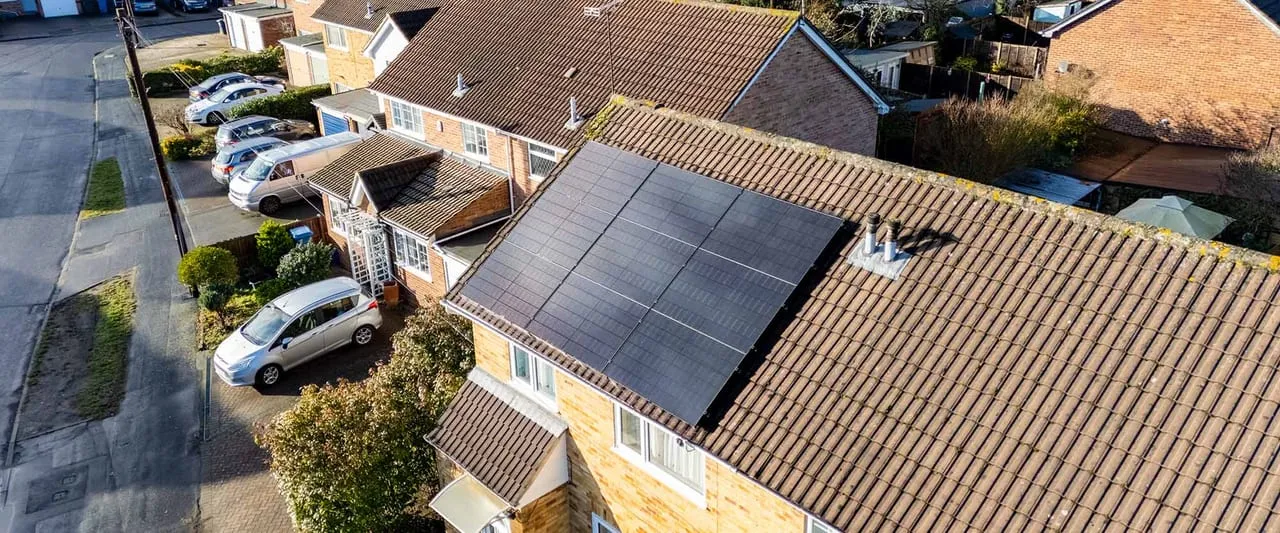
Every few months the search term spikes again: “free solar panels UK.” It has been driving traffic since around 2011, and it has been substantially wrong for most of that time. In 2026 there is still no universal government scheme handing out free solar panels — but there is a real, means-tested route that can get some households a fully-funded system, and understanding the difference is worth ten minutes of anyone’s time before they hand a phone number to a lead-gen site.
Where “free solar” actually came from
The phrase has a real origin, not just a marketing myth. Between roughly 2010 and 2015, before the Feed-in Tariff (FiT) was cut hard, several UK companies ran genuine “rent-a-roof” schemes. A company fitted solar panels on a homeowner’s roof at no upfront cost, then kept the FiT generation and export payments for itself — sometimes for 20-25 years — while the homeowner got free daytime electricity in exchange for the roof space. It was a real commercial model, not a scam by design, and thousands of UK roofs still carry rent-a-roof panels today.
The problem was in the fine print. Many contracts:
- Ran for 20-25 years and were registered against the property title, not just the homeowner — meaning sellers had to disclose the panels and buyers had to accept a long-dated third-party lease, which caused conveyancing delays and mortgage-lender refusals for years afterwards.
- Gave the homeowner none of the FiT income, only the offset electricity savings — a much smaller share of total value than owning the system outright.
- Left maintenance, inverter replacement, and roof-penetration liability vague in poorly-drafted agreements.
- Assumed panel and inverter lifespans that didn’t always match reality — a typical string inverter needs replacing after 10-15 years (roughly £500-£1,000), a cost some rent-a-roof agreements never clearly assigned to either party. For a full breakdown of what ownership actually costs today, see thecostofsolar.co.uk’s cost-of-solar-panels guide.
The FiT closed to new applicants in 2019, replaced by the Smart Export Guarantee (SEG), which pays a market-set export rate rather than a fixed subsidy. That single change killed the rent-a-roof business model stone dead — there was no longer a 20-year subsidy stream for a third-party investor to harvest. Any site still actively pitching a new “rent your roof for free panels” deal in 2026 is either recycling old content or, more worryingly, running a variant of the model without disclosing that the SEG economics don’t support it the way FiT once did.
Is there ANY genuinely free solar scheme in 2026?
Not a universal one. It’s worth being blunt about this because the search intent behind “free solar panels UK” is overwhelmingly hope, and hope is exactly what low-quality lead-gen sites monetise.
What does exist:
- ECO4 (Energy Company Obligation, phase 4) — a real, government-mandated scheme requiring large energy suppliers to fund efficiency measures, including solar PV in some cases, for low-income and fuel-poor households. It’s means-tested: eligibility generally requires the household (or a member of it) to be on a qualifying benefit, and the property typically needs a poor EPC rating (D-G) for the measure to make sense as part of a wider retrofit. It is not a “sign up and get free panels” website form — it runs through accredited installers and suppliers, and solar is usually bundled with insulation or heating measures rather than offered alone. eco4application.co.uk is a reasonable starting point to check the actual criteria rather than guessing from a headline.
- GBIS (Great British Insulation Scheme) — similarly means-tested, and focused on insulation rather than solar, but often mentioned in the same breath by lead-gen sites conflating schemes. Worth checking gbisapplication.co.uk if insulation is the actual need.
- Home Energy Scotland — interest-free loans (not grants) for solar and battery storage north of the border, which is a genuinely useful route for Scottish households even though “loan” and “free” are not the same word.
- Council-administered local grants — some councils run their own limited-pot schemes, usually tied to fuel poverty or specific housing stock; councilhousegrants.co.uk and fuelpovertyhelp.co.uk are useful for tracking what’s live locally, because these pots open and close on local budgets, not a national calendar.
What does not exist in 2026:
- A national “free solar panels for everyone” grant. If a site or cold caller claims this without asking a single question about your benefits status or EPC rating, that’s the tell.
- Free solar as part of the Boiler Upgrade Scheme — that scheme pays £7,500 towards an air source heat pump, and it does not fund solar PV at all. This is one of the most common conflations in searches, presumably because both sit under “renewable home upgrades” in people’s minds.
- FETF-branded solar grants for homes — the Improving Farm Productivity grant (roughly 25% of eligible cost in England; rates vary by devolved nation) is an agricultural business grant, not a residential scheme, and it is not 40% no matter what an old blog post says.
Why the “free” hook still works — and who’s still using it
Search volume for “free solar panels” style terms persists for a straightforward reason: it costs a lead-gen operator almost nothing to rank a page with that headline, and every visitor who fills in a form because they thought a grant was involved is a warm lead an installer will pay for, whether or not real “free” money ever changes hands. The commercial incentive to keep the phrase alive online has nothing to do with whether the underlying grant exists.
A few things worth flagging for anyone in the trade fielding these enquiries:
- freesolarpanelsengland.co.uk is a good example of the genre worth checking directly rather than assuming — sites with domain names built entirely around the “free” promise deserve more scrutiny than a normal installer or comparison site, not less, precisely because the domain itself is the marketing hook. Read past the headline to the actual eligibility mechanism being described (in this case, the same ECO4/benefits criteria covered above) before treating a lead as qualified.
- Genuine ECO4 and GBIS leads convert differently from “free solar” leads: they come with a benefits/EPC qualification step baked in, so volume is naturally lower and closer to true eligibility. A spike in raw “free solar” form-fills with no benefits data attached is a strong signal the traffic source is over-promising.
- 0% VAT on residential solar and battery storage installations (in Great Britain, until 31 March 2027, after which it’s scheduled to revert to 5%) is real and substantial — it’s arguably the single most under-marketed “free money” story in the sector right now, because it’s not free panels, it’s a straightforward saving on labour and materials that every installer should be quoting inclusive of. That’s a much better story to lead with than a grant that doesn’t exist.
What “not free” actually costs, and why it still pays for itself
For anyone landing on a “free solar” page out of genuine cost anxiety rather than genuine grant-seeking, the honest answer is usually more reassuring than they expect. A typical 4kW residential system installed in 2026 runs roughly £6,000-£8,000 (a smaller 3kW system closer to £5,000; a larger 10kW system £13,000-£17,000), and with 0% VAT that’s the whole invoice, not a pre-tax figure. Battery storage adds roughly £4,000-£8,000 depending on capacity and brand — a Tesla Powerwall 3 at 13.5kWh sits around £8,500-£10,500 installed.
Modern N-type panels (TOPCon, HJT or ABC cell technology) degrade at around 0.4% a year and are commonly warrantied for 25-30 years, so the maths on payback matters more than a mythical free installation. UK yield averages around 850 kWh per kWp per year nationally, rising to 1,050+ kWh/kWp in the sunniest southern counties, and with import electricity around 25p/kWh under the current Ofgem price cap plus SEG export rates typically in the 12-20p/kWh range from better suppliers, payback periods for a well-sized system are commonly in the 6-10 year range against a 25+ year panel life. That’s not “free,” but on a 25-year asset it’s a strong return, and it’s one reason installers across the network — from ecoaim.co.uk in Livingston to fldelectrical.co.uk in Swansea — spend more time now explaining VAT and payback than chasing grant enquiries that rarely convert.
For a genuinely local example of the sums, greenlincrenewables.co.uk in Lincolnshire and electrifusionsolutions.com in Doncaster both quote against real roof surveys rather than a generic national average, which is the only way “does this pay for itself” gets answered honestly for a specific house.
Commercial and landlord angles get conflated too
The domestic “free solar” search noise regularly bleeds into commercial queries, and the schemes are entirely different animals. Landlords searching around EPC compliance deadlines sometimes land on residential “free grant” content when what they actually need is guidance on MEES compliance and EPC minimum standards for let property, which is a regulatory deadline problem, not a grant-seeking one. Commercial building owners chasing “free solar for my warehouse” are better served starting from an actual cost baseline — solarpanelsforwarehouses.co.uk and commercialsolarcostuk.co.uk both set out realistic £/kWp figures (commercial installs typically run £900-£1,200/kWp) rather than grant fiction, and for larger portfolios a Power Purchase Agreement via a site like solarpowerpurchaseagreements.co.uk is the closest legitimate thing to “no capital outlay solar” that exists commercially — because unlike rent-a-roof, PPA contracts in 2026 are transparent, competitively tendered, and don’t rely on a subsidy that no longer exists.
What to tell a customer who asks about “free solar”
For installers and their marketing teams, the practical answer is straightforward:
- Ask about benefits status and EPC rating early — if neither applies, ECO4/GBIS routes are closed to them and it’s kinder to say so than to run them through a qualification form that will fail.
- Lead with 0% VAT as the real, current saving — it’s bigger than most people expect and it’s not conditional on anything except installing before 31 March 2027.
- If they own an older rent-a-roof property (as buyer or seller), flag that the lease attaches to the title — this is a conveyancing issue worth a solicitor’s attention, not a reason to assume the panels are worthless.
- For genuinely low-income households, point them at accredited ECO4/GBIS routes rather than generic “free solar” search results, and expect a real means-test, not a marketing form.
The underlying data point worth remembering: 2025 was a record year for UK solar, with 257,397 MCS-certified installations (+32% year on year) and roughly 21.6 GW of cumulative deployed capacity, now supplying about 6.4% of UK electricity. None of that growth was built on free panels — it was built on falling install costs, VAT relief, and batteries making self-consumption worthwhile. That’s a far more durable story than a grant that stopped existing in 2019, and it’s the one the industry should be telling. For more on where the installer market is heading through the rest of 2026, see Solar Weekly’s UK solar industry overview and, on the marketing side of qualifying leads properly rather than chasing “free” search volume, our piece on solar installer marketing.