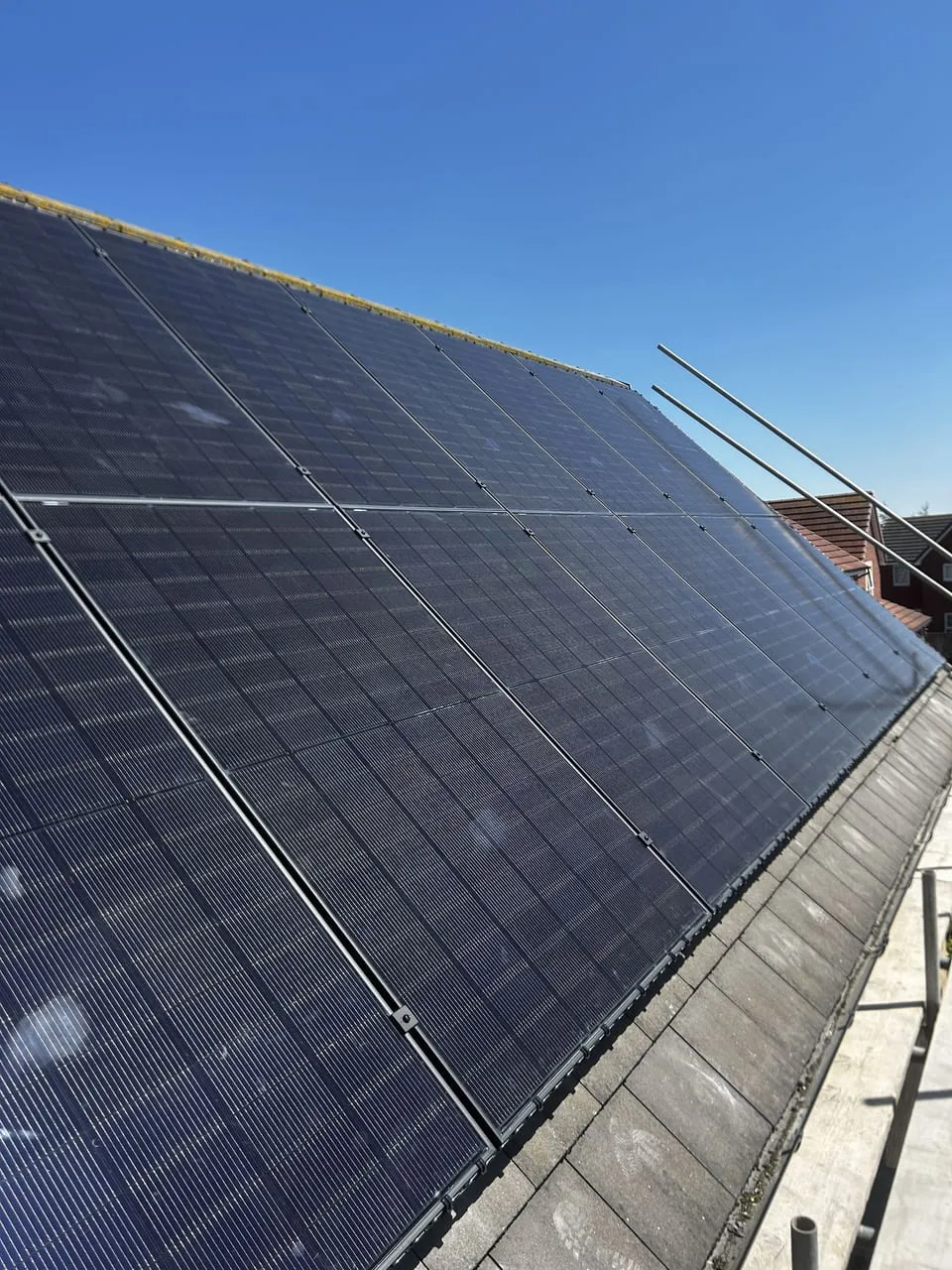
A solar case study is the single hardest-working asset an installer produces — and the most badly written. Most read like a spec sheet with a customer’s name bolted on: panel count, kWp, “very happy with the results.” None of that closes a sale. What actually persuades a commercial buyer or a homeowner comparing three quotes is a narrow set of numbers, told honestly, backed by a photo you’re legally allowed to use. This is a working guide to the metrics, the rights issues, and the sector targeting that turn a case study from a portfolio filler into a genuine sales tool.
Why most case studies don’t convert
The typical UK installer case study is written for the installer’s own pride, not the reader’s decision. It leads with system size (“a 6kW array with 10 panels”), spends a paragraph on the brand of inverter, and closes with a generic quote about “excellent service.” None of that answers the only question a prospect actually has: if I do this, what happens to my costs, and how do I know it’ll work for a site like mine?
Buyers — especially commercial ones — are running an implicit cost-benefit model in their head. Your case study should hand them the two or three numbers that model needs, sourced from a real project, not a brochure average. Everything else is decoration.
The metrics that actually persuade
Payback period, calculated honestly
Payback is the number every commercial prospect converts everything else into. If you’re publishing a case study without a payback figure, you’re leaving the most persuasive line out of the piece.
Two things make a payback claim credible rather than marketing fluff:
- Show your working. State the system cost, the annual saving, and the arithmetic — not just “pays for itself in 4 years.” A commercial-scale system at roughly £900–£1,200/kWp installed, offsetting electricity bought at around 25p/kWh, gives a reader something they can sanity-check against their own site.
- Separate self-consumption savings from export income. A site that uses 80% of what it generates on-site is a fundamentally different economic story from one exporting most of it at a Smart Export Guarantee rate — SEG tariffs vary a lot by supplier, roughly 12–20p/kWh at the better end, so don’t imply a fixed national rate.
For readers who want the underlying cost assumptions rather than a single project’s numbers, thecostofsolar.co.uk’s commercial solar panel cost breakdown is a useful companion reference to link from a case study page — it lets the case study stay concrete and specific while the cost logic behind it is fully documented elsewhere.
Self-consumption percentage
This is the metric most UK case studies skip entirely, and it’s arguably more important than system size. A 50kWp array on a warehouse roof that runs three shifts and consumes 90% of its own generation on-site is a far stronger sell than a 50kWp array on a site that’s empty at weekends and exports half its output at a modest SEG rate.
State it plainly: “the array covers roughly X% of daytime demand on-site.” If you have half-hourly data from the customer’s smart meter or the inverter monitoring portal, even better — show a simple bar or line comparing generation to demand across a working day. This single chart does more to establish credibility than three paragraphs of testimonial copy, because it’s a claim a sceptical facilities manager can be shown, not just told.
Yield and generation, contextualised by location
Don’t just state annual kWh generated — contextualise it against expected yield for the region. UK solar yield typically runs around 850 kWh per kWp per year nationally, rising to 1,050+ kWh/kWp in the sunniest parts of the south. If your case study is a Yorkshire or Scottish installation performing at 820 kWh/kWp, that’s a good result and worth saying so explicitly, rather than leaving a reader to wrongly assume it underperformed a headline “1,000 kWh/kWp” figure quoted from a southern-England install.
This is where sector and geography specificity earns its keep. A dairy farm install and a distribution-centre roof have completely different demand profiles even at identical yield — say so.
Degradation and lifetime, not just year-one numbers
Case studies that only show year-one savings implicitly invite the reader to wonder what happens in year 15. Modern N-type panels (TOPCon, HJT, ABC) degrade at roughly 0.4% a year and are commonly warrantied for 25–30 years, so it’s legitimate — and persuasive — to show a simple 25-year cumulative saving projection alongside the year-one figure, clearly labelled as a projection built on the manufacturer’s degradation curve rather than a guarantee. Mention the string inverter honestly too: a 10–15 year lifespan with a realistic £500–£1,000 replacement cost is a credibility signal, not a weakness, when you disclose it rather than bury it.
Battery attach-rate numbers, where relevant
If the project included storage, quote the actual battery cost band (roughly £400–£700/kWh installed, or circa £8,500–£10,500 for something like a 13.5kWh Tesla Powerwall 3) and explain why storage made sense for that specific site — arbitrage against time-of-use tariffs, backup for critical loads, or simply raising self-consumption on a site with a poor daytime/night-time demand match. A battery number without a “why” reads as an upsell; a battery number with a clear demand-shape rationale reads as engineering judgement.
Photo rights — the part installers get wrong
This is the least glamorous part of case study production and the one most likely to create a real legal problem, not just a weak asset.
Get it in writing, at the point of installation, not months later when you want to publish. A line in the completion paperwork — “customer/business consents to photography of the completed installation being used in [installer]‘s marketing, including on the website and in case studies” — takes thirty seconds to add and closes the gap entirely. Retrofitting consent after a homeowner has gone quiet on emails is a real and common failure mode.
Commercial sites need a named signatory, not a verbal nod from whoever was on-site that day. Facilities managers aren’t always authorised to approve external marketing use of a client’s premises. Get sign-off from someone who actually holds that authority, and keep the email trail.
Drone photography has its own rules. If you’re using a drone to shoot a warehouse or farm roof, you need to operate within CAA rules (A2 Certificate of Competency or a GVC as appropriate, depending on the drone’s weight and how close you’re flying to people/property) — and separately, the landowner’s permission to fly over their site isn’t automatically covered by consent to photograph the installation. Ask for both.
Anonymise when consent doesn’t stretch to full attribution. Plenty of case studies are still highly persuasive without a company name — “a 120kWp installation on a cold storage facility in the East Midlands” carries the numbers just fine. Don’t let a photo-rights gap kill an otherwise strong case study; strip identifying details and use the data.
Before/after and thermal imagery need particular care. If you’re using thermal camera output to show heat loss or panel performance, make clear in the caption what the image actually represents — thermal imagery is easy to over-read, and an unlabelled thermal photo can look like a fabricated claim even when it isn’t.
Targeting the right sector story
A single generic “commercial solar case study” undersells what you’ve actually built. Sector-specific framing does more work than most installers realise, because the reader is trying to map your project onto their own site, and generic language makes that harder.
- A cold-storage or refrigeration site cares about a completely different load profile to an office — daytime and often overnight demand is high and fairly constant, which changes the payback and self-consumption story considerably. If that’s your project, say so, and consider cross-referencing sector-specific detail on a hub like solarpanelsforcoldstorage.co.uk rather than writing generic commercial copy that could apply to any roof.
- Distribution and logistics sites have their own demand shape again — conveyor and dock-leveller loads, EV charging for a growing fleet, and often flat roofs with genuinely large usable areas. solarpanelsfordistributioncentres.co.uk and solarpanelsforlogistics.co.uk are useful sector reference points if you’re writing up a project in that space and want the case study to sit alongside credible category context.
- Farm and agricultural installs have a grant landscape worth getting right in the write-up: England’s relevant scheme is the Improving Farm Productivity grant, covering roughly 25% of eligible cost — not the older FETF 40% figure some installers still quote, which is a different scheme with different eligibility. Rates differ by UK nation, so state which one applied. If your case study is agricultural, a sector hub like solarpanelsforfarms.uk or solarpanelsfordairyfarms.co.uk gives useful comparative detail for readers checking your numbers against the wider sector.
- Care homes, schools and churches all carry procurement and trustee-approval dynamics that a residential-style case study doesn’t address — budget-holders in these sectors often need a payback and risk case robust enough to present to a board or PCC, not just a homeowner-style testimonial.
If you’re an installer building out a case study library and want to see how sector hubs structure this kind of content at scale, commercialsolarpanelsinstallation.co.uk is a reasonably comprehensive reference point for how UK commercial solar content is typically organised by building type.
Two real installer examples worth studying
It’s worth looking at how working installers actually present projects rather than theorising in the abstract. ecoaim.co.uk, covering Central Scotland from its Livingston base, and greenlincrenewables.co.uk — sorry, correctly: greenlincrenewables.co.uk, covering Lincolnshire — both operate in regions with meaningfully different yield expectations to the south of England, which is exactly the kind of detail a case study should surface rather than smooth over with a national-average figure. Similarly, an installer like fldelectrical.co.uk working across Swansea and South Wales, or drenergyltd.co.uk doing commercial-scale work out of Bristol, will have project data — roof orientation quirks, shading from adjacent structures, local grid connection timelines — that’s genuinely regional and genuinely differentiating if it’s written up properly instead of generalised away.
Structure: what to actually put on the page
A format that holds up across sectors:
| Section | What goes here |
|---|---|
| The brief | Site type, why the customer approached you, any constraints (roof condition, grid capacity, budget) |
| The numbers | System size (kWp), install cost band, annual generation, self-consumption %, payback period with working shown |
| The context | Regional yield comparison, sector-specific demand profile, grants/incentives that actually applied |
| The photo | Consented, captioned, dated — drone shots need CAA compliance noted if relevant |
| The result | 12-month (or longer, if available) actual performance vs. projection — say if it beat, matched, or slightly missed forecast, and why |
That last row matters more than installers think. A case study that admits a system came in 5% below projected yield because of an unexpected shading issue, and explains how that was accounted for in the payback recalculation, is more credible than one claiming everything landed exactly on forecast. Buyers have seen enough marketing to be suspicious of perfect numbers.
The commercial context worth linking
If you’re publishing case studies to support a wider commercial sales push, it’s worth anchoring the payback and finance detail against independently published cost data rather than restating your own numbers in isolation — thecostofsolar.co.uk/commercial-solar-panel-costs/ and the broader payback-period reference at thecostofsolar.co.uk/solar-panel-payback-period-uk/ both give a reader a way to cross-check your figures against sector norms, which strengthens rather than dilutes your own case study’s credibility. For projects involving finance structures rather than outright purchase, commercialsolarfinance.co.uk and solarassetfinance.co.uk are relevant reference points if the case study involved a lease, PPA, or asset finance arrangement rather than a cash purchase — worth naming the finance route explicitly in the write-up, since it changes the payback maths considerably.
Remember also that VAT context dates a case study, for better or worse: 0% VAT applies to residential solar and battery storage installed in Great Britain until 31 March 2027, after which it’s scheduled to revert to 5%. If you’re publishing a project completed under the 0% window, say so and date it — it’s a genuine, time-limited fact that adds credibility rather than urgency-manufacturing.
The practical takeaway
A case study earns trust by being specific where a brochure is vague: a real payback figure with the arithmetic shown, a self-consumption percentage rather than a generic “high efficiency” claim, degradation and inverter-lifetime honesty instead of a year-one-only snapshot, and photography you can actually prove you’re entitled to use. Sector framing — cold storage versus distribution versus farm versus care home — does more persuasive work than most installers give it credit for, because it lets the reader map your project onto their own site rather than making them do that translation themselves. Get the consent paperwork sorted at project completion, not months later when you need the asset, and the rest of this is simply a matter of showing your working.