Battery attach rates on UK residential solar installs have climbed steadily since 2023, and 2026 is the year the conversation shifted from “should I add a battery” to “which brand, and why.” With 0% VAT on both solar and battery storage running until 31 March 2027, homeowners are stacking storage onto new PV systems at a rate installers haven’t seen before — and the brand landscape underneath that demand has changed shape. This is a look at who’s actually being fitted, why, and what it means for margin.
The market backdrop: why brand choice matters more in 2026
Storage used to be an afterthought bolted onto a solar quote. That’s no longer true. MCS recorded 257,397 certified installations in 2025 (+32% year on year), with roughly 21.6 GW of solar now deployed across the UK — around 6.4% of national electricity supply. A meaningful share of that growth is retrofit battery attach, driven by three things: the 0% VAT window closing in 2027, rising confidence in Smart Export Guarantee (SEG) rates from suppliers willing to pay 12–20p/kWh at the top end, and import prices sitting around 25p/kWh under the Ofgem cap, which makes self-consumption arithmetic increasingly attractive.
That backdrop means the brand an installer specifies isn’t just a technical decision — it’s a commercial one. Warranty terms, distributor margin structures, install labour time, and homeowner-facing brand recognition all vary significantly between the five names that dominate installer conversations right now: GivEnergy, Fox ESS, Sunsynk, Sigenergy and Tesla.
GivEnergy: the UK installer’s default
GivEnergy has built its position less on being the cheapest kWh and more on being the easiest to sell and service in the UK specifically. It’s a British-headquartered brand (Stallingborough, Lincolnshire), which plays well with customers who’ve grown wary of no-name Chinese battery packs after a few high-profile failures in the wider industry. Its All in One and Gen 2 hybrid ranges are stackable — meaning an installer can start a customer at 5.2kWh or 9.5kWh and add further battery modules later without swapping the inverter — which is a genuinely useful sales tool for budget-conscious homeowners who want to “add capacity next year.”
For installers, the appeal is largely around distribution and support: UK-based technical support, established installer training, and an app/monitoring platform that homeowners find intuitive enough that it cuts down on aftercare calls. Margin-wise, GivEnergy sits in the middle of the market — not the cheapest landed cost, but predictable enough that installers can price confidently without eating into contingency. It’s frequently the default recommendation from installers who want a straightforward “no drama” spec, something Yorkshire-based YEERS will recognise from its own solar-plus-battery-plus-EV customer base, where simplicity of the aftercare relationship matters as much as the spec sheet.
Fox ESS: the technical spec-sheet brand
Fox ESS has carved out a reputation as the brand installers reach for when a customer asks harder technical questions — round-trip efficiency, hybrid inverter flexibility, three-phase compatibility for larger domestic or small commercial jobs. Fox’s ECS4100/ECS2900 stackable batteries and hybrid inverter range give installers a genuinely modular system that scales from a modest retrofit up to something closer to small commercial capacity, without changing brand halfway through a project.
The commercial angle matters here: Fox’s three-phase hybrid inverters make it a natural fit for installers who move between domestic and small commercial work — barns, outbuildings, small industrial units — rather than staying purely residential. That crossover capability is increasingly relevant given how much of the storage growth conversation is now happening on the commercial side too, an area covered in depth on batterystorageforbusiness.co.uk for installers weighing up whether to pitch storage alongside commercial PV rather than as a residential-only product line.
Sunsynk: value entry point, but check the distributor relationship
Sunsynk built its UK volume on price — its hybrid inverters and battery packs are generally the most competitively landed cost of the mainstream brands, which matters for installers competing on quotes against national chains and marketplace-driven price comparisons. The trade-off installers report is more variance in distributor support quality: because Sunsynk is sold through several different UK distributors rather than one tightly controlled channel, warranty handling and spares availability can differ depending on who you bought through, which is worth factoring into any quote that promises a fast callout response.
Where Sunsynk tends to win jobs is with price-sensitive retrofit customers adding a battery to an existing PV array purely to chase self-consumption savings, rather than customers wanting a premium unified brand experience. Installers who lean into that value positioning — genuinely stacking savings math rather than lifestyle brand appeal — will find good supporting reference material in the payback calculations on thecostofsolar.co.uk’s battery storage cost breakdown, useful for setting realistic customer expectations before the quote stage.
Sigenergy: the newer integrated challenger
Sigenergy is the brand installers are asking most questions about right now, and for good reason — it’s positioning itself as a fully integrated hybrid ecosystem (inverter, battery, EV charging and, increasingly, heat pump control) under one app and one warranty, rather than a battery bolted onto a third-party inverter. For installers, that integration cuts commissioning time once you’re trained on the platform, and it’s a genuinely strong pitch to homeowners who want “one system, one app” rather than stitching together inverter brand A with battery brand B.
The catch is availability and training lead time — as a newer entrant to UK distribution, Sigenergy-trained installer coverage is patchier regionally than the more established brands, and stock has at times lagged demand. Installers who’ve got ahead of the training curve are using it as a differentiator against competitors still quoting older hybrid architectures, particularly on jobs where the customer is also asking about EV charging in the same conversation — a bundled-sale pattern more retrofit specialists are starting to build entire quotes around.
Tesla Powerwall: the brand customers ask for by name
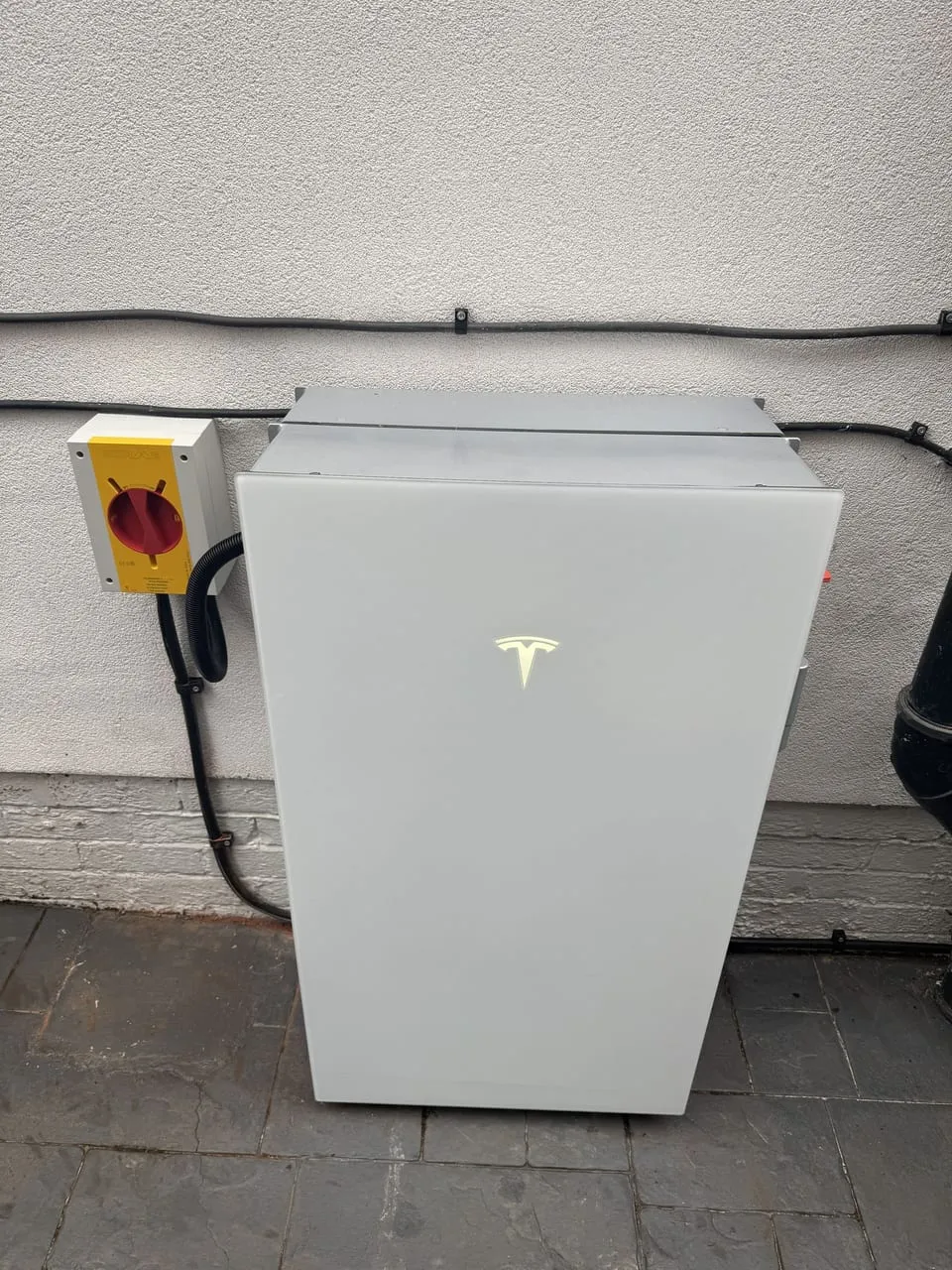
Tesla is the outlier on this list because its position isn’t really about installer preference — it’s about consumer pull-through. Powerwall 3 (13.5kWh) is the battery homeowners have actually heard of, largely off the back of Tesla’s EV brand halo, and it’s not unusual for a customer to ask for it by name before an installer has even proposed a spec. At roughly £8,500–£10,500 installed, it sits at the premium end, and installer margin is generally tighter than on GivEnergy or Fox because Tesla controls pricing more centrally through its certified installer network.
Where Tesla earns its place on a quote is integrated households already running a Tesla vehicle or considering one, where the single-app ecosystem argument genuinely lands. It’s a smaller share of overall UK installs than its brand recognition would suggest, but it’s rarely absent from a shortlist when a customer has done their own research before calling an installer.
Stackable vs integrated: the real decision installers are making
Underneath the brand names sits a more fundamental architectural choice that shapes both the sale and the margin: stackable modular batteries (GivEnergy, Fox, Sunsynk) versus fully integrated all-in-one systems (Sigenergy, Tesla Powerwall).
Stackable systems win on flexibility and initial price point — a customer can start smaller and add capacity later, which suits phased budgets and works well against price-anchored competitor quotes. Integrated systems win on installation speed, warranty simplicity (one manufacturer, one number to call), and increasingly on the EV-charging-and-battery bundled sale, which is becoming a meaningful revenue line for installers who’ve built that capability. Installers working commercial as well as residential jobs will recognise the same tension playing out at larger scale on the guidance covered by commercialsolarcanopy.co.uk and solarpanelsforindustrialunits.co.uk, where modular battery banks are typically favoured for scalability across a phased commercial rollout.
Margin angles installers should actually be modelling
A few practical points worth building into any brand-comparison spreadsheet rather than trusting supplier price lists alone:
| Factor | Stackable (GivEnergy/Fox/Sunsynk) | Integrated (Sigenergy/Tesla) |
|---|---|---|
| Typical install labour | Slightly longer (separate inverter + battery commissioning) | Faster (single unit, pre-integrated) |
| Warranty complexity | Split across inverter/battery manufacturers | Single manufacturer warranty |
| Upsell path | Easy — add modules later | Harder — often a full swap |
| Installer margin | Mid-range, more competitive on price | Tighter on Tesla; improving on Sigenergy as distribution matures |
| Customer brand pull | Installer-led recommendation | Increasingly customer-led (especially Tesla) |
None of these figures are fixed nationally — distributor terms, regional stock, and installer certification level all move the numbers, so this is a framework for comparison rather than a rate card.
It’s also worth remembering what battery brand choice doesn’t change: SEG rates are set by the supplier the household exports to, not the battery manufacturer, so no brand “guarantees” a better export rate — that’s a common misconception worth correcting at the quote stage. Similarly, the Boiler Upgrade Scheme’s £7,500 grant is for air source heat pumps and has no bearing on battery storage costs; installers bundling heat pump and battery quotes should keep those funding streams clearly separated for the customer.
For installers building out their own storage offer, real-world regional examples are worth watching rather than theorising from spec sheets alone. ecoaim.co.uk in Livingston and greenlincrenewables.co.uk in Lincolnshire have both built battery attach into their standard retrofit conversation rather than treating it as an upsell, while premierelectricalrenewables.co.uk covers the EV-charging-plus-battery bundle that’s increasingly where the integrated-brand argument wins jobs. On the maintenance side, solarmaintenancesolutions.com is a useful reference for how aftercare load differs across these brands once systems are a few years old — a factor too many installers under-price at the quote stage.
The takeaway
There’s no single “best” battery brand in the UK market right now — there’s a best fit for a given customer’s budget, technical requirement and appetite for future expansion. GivEnergy remains the safe, UK-supported default; Fox ESS wins the technically demanding and small-commercial crossover jobs; Sunsynk competes hardest on price with more variable distributor support; Sigenergy is the integration play worth training up on now before competitors do; and Tesla sells itself on brand pull rather than installer margin. The installers building the strongest storage revenue line in 2026 are the ones who’ve stopped picking one brand and instead match the brand to the customer conversation — before the 0% VAT window narrows the decision for everyone in March 2027.