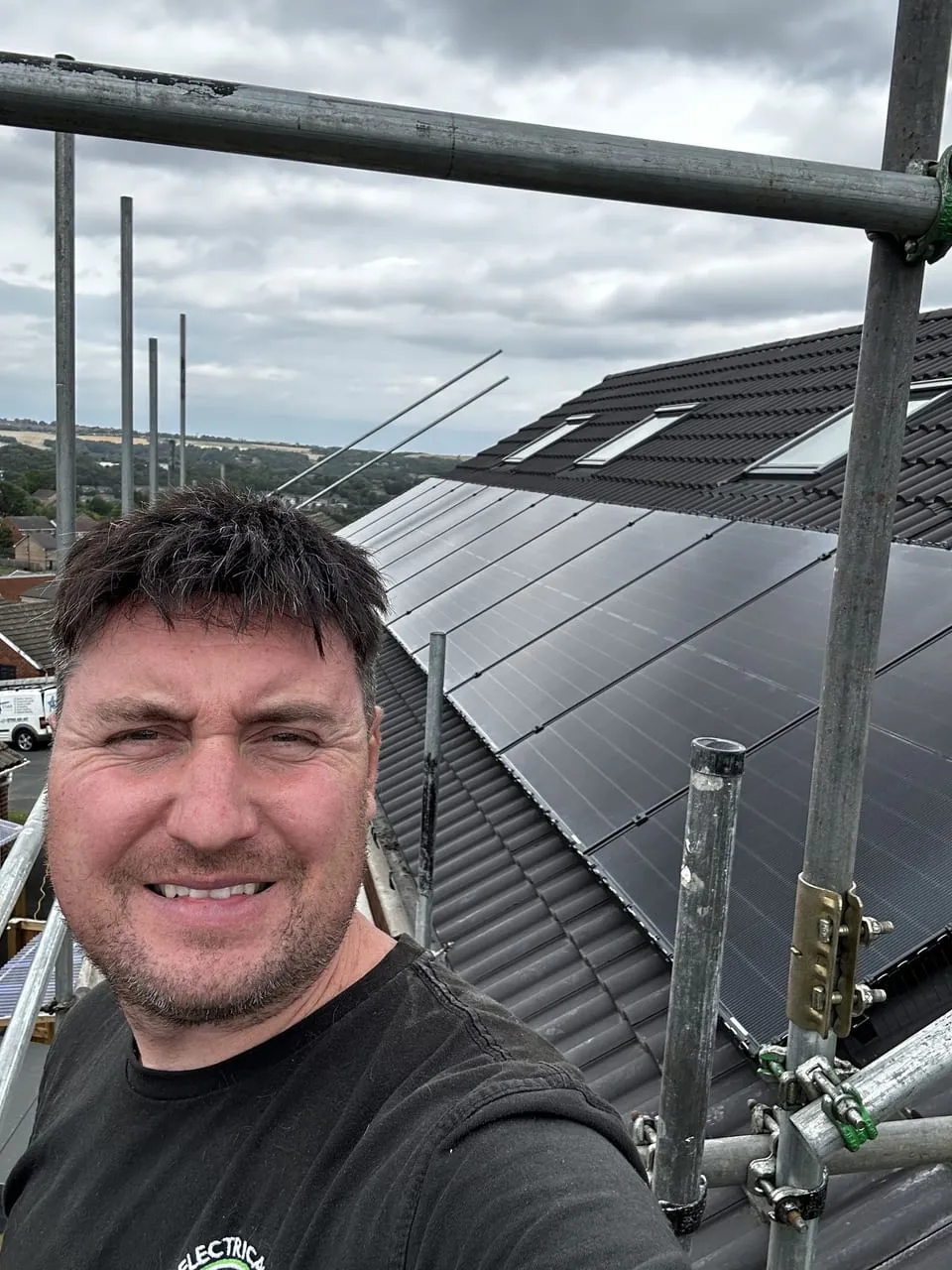
Every domestic and commercial EPC assessment in the UK produces a document that most solar installers never see, despite it containing exactly the intelligence their sales teams are paying lead-generation companies for: a property’s current energy performance, its recommended improvements, and — for landlords — a hard compliance deadline. There are roughly 1.5 million EPCs lodged in England and Wales alone each year, and a meaningful share of those properties are flagged for solar PV, battery storage, or fabric upgrades that installers could quote on directly. Almost none of that referral pathway is formalised. This is the gap.
Why EPCs are a solar lead signal, not just a compliance document
An Energy Performance Certificate isn’t simply a letter grade stuck on a property listing. It’s a structured dataset: current SAP/RdSAP score, potential score after improvements, a ranked list of recommended measures, and (on the commercial side) an EPC banding that increasingly determines whether a building can legally be let at all. When an assessor walks a property, they are already looking at roof orientation, existing heating system, glazing, insulation levels and consumption patterns — the same inputs a solar installer needs for a preliminary quote.
The problem is structural, not technical. EPC assessors are licensed, trained, and paid to produce a compliant certificate — not to sell renewables. Most have no commercial relationship with an installer, so a property that’s crying out for solar (south-facing roof, high consumption, EPC band D with “install solar water heating” or “install PV panels” as a recommended measure) simply gets its certificate lodged and the opportunity evaporates. For installers who’ve built structured referral relationships with assessors, that same certificate becomes a warm introduction with the technical groundwork already done.
The MEES deadline is compressing the timeline for landlords
This matters more in 2026 than it did five years ago because of the Minimum Energy Efficiency Standards (MEES) trajectory for the private rented sector. Landlords already can’t let a property with an EPC below E, and the direction of travel — tightening thresholds for both domestic and non-domestic rented stock — means EPC assessors are fielding a rising volume of “what do I actually need to do” conversations from anxious landlords. That conversation is the natural entry point for a solar and battery quote, particularly on commercial and mixed-use stock where a single assessment might cover a whole portfolio.
This is precisely the audience served by landlordepccompliance.co.uk, which exists to translate MEES obligations into a landlord action plan — and by extension, into the kind of retrofit works (fabric first, then generation) that a solar quote naturally follows. An installer with a standing referral arrangement with a firm of assessors, or with a landlord-compliance specialist, is getting introduced at the exact moment the client is deciding what to spend money on.
On the commercial side, the calculus is sharper still. A commercial EPC assessor working through an industrial estate or an office park is seeing exactly the roof area, daytime consumption profile and half-hourly meter data that make a building a strong solar candidate. commercialepcassessors.co.uk sits in that commercial assessment space, and it’s a natural partner for installers targeting warehouses, distribution sheds and light-industrial stock where the EPC banding conversation and the solar payback conversation are, in practice, the same meeting.
What the referral mechanics actually look like
A workable EPC-to-solar pipeline isn’t a vague “send us your leads” arrangement — it needs a mechanic that respects the assessor’s independence (they can’t be seen to be pushing a specific installer as a condition of the assessment) while still creating a genuine, trackable handoff. In practice, the arrangements that work fall into three patterns:
1. Post-assessment information pack. The assessor hands over (or emails) a neutral information sheet listing solar/battery as one recommended measure alongside insulation and glazing, with two or three vetted installer contacts — not one. This keeps the assessor’s independence intact under RICS/accreditation-body rules while still generating a warm introduction.
2. Reciprocal directory listing. The installer lists the assessor (or firm of assessors) as a recommended partner on their own site for “what does my EPC mean” queries, and the assessor reciprocates for “solar installer near me” queries. This is a genuine two-way value exchange rather than a paid referral, which matters both for trust and for avoiding any suggestion of a kickback arrangement that could compromise the assessor’s impartiality.
3. Portfolio-level relationship with letting agents and property managers. Many EPC assessors work through the same letting agents and managing agents repeatedly. An installer that becomes the “go-to” for that agent’s portfolio — via the assessor’s recommendation — can pick up a running stream of landlord enquiries rather than one-off jobs.
| Referral mechanic | Assessor independence risk | Lead quality | Typical volume |
|---|---|---|---|
| Post-assessment info pack (2-3 installers) | Low — neutral, multi-option | High — pre-qualified by roof/consumption data | Steady, low-volume |
| Reciprocal directory listing | Very low — no assessment-linked promotion | Medium — cold-ish, SEO-driven | Variable |
| Letting/managing agent portfolio relationship | Low if disclosed | Very high — recurring, compliance-driven | Can spike around MEES deadlines |
The common thread: the referral has to be additive to the assessor’s core job, not a commission-driven distortion of it. Installers who approach assessors with “give us your leads and we’ll pay you per conversion” tend to get politely declined, or worse, create a compliance headache for the assessor. Installers who approach with “here’s a one-page explainer your clients can use, no obligation, and we’ll return the favour” get a much warmer reception.
Where this fits for installers already doing solar and electrical work
For installers already covering both trades, the EPC referral channel slots in naturally alongside existing retrofit and rewiring work. ElectriFusion Solutions in Doncaster and South Yorkshire, for example, already fields a mix of solar and electrical work where an EPC recommendation for rewiring or consumer unit upgrades often sits right next to the solar PV recommendation on the same certificate — meaning a single assessor relationship can generate two separate quote conversations from one document. Similarly, AMP Pro Electrical covers electrical and renewables work in the same Doncaster patch, and either installer building a standing relationship with local assessors covering that housing stock would see a meaningfully different lead mix to relying on paid ads alone.
On the commercial side, EC Eco Energy in Essex and East Anglia is well placed to pick up the commercial-EPC-to-solar pipeline on the industrial and warehouse stock that dominates that region — a natural fit given how often commercial EPC recommendations for that building type point straight at rooftop PV and battery storage as the most cost-effective compliance route. And for installers covering Lincolnshire’s mixed agricultural and light-industrial base, Greenlinc Renewables sits in a good position to build the same kind of assessor relationships across farm buildings and rural commercial stock, where EPC assessments and MEES compliance deadlines are increasingly driving the initial enquiry.
The commercial property angle: EPC banding as a solar trigger
The sharpest version of this opportunity sits with commercial property. Non-domestic MEES thresholds are the single biggest compliance-driven trigger in the market right now, and a commercial EPC assessment that flags a building below the required band puts the landlord in a position where they need to act — not eventually, but before the next let or lease renewal. Solar PV, sometimes paired with battery storage, is frequently the single highest-impact, best-payback measure available on industrial and warehouse roof stock, because those buildings combine large unshaded roof areas with daytime-heavy consumption profiles that suit self-consumption well.
Hub sites like solarpanelsforwarehouses.co.uk and solarpanelsforindustrialunits.co.uk exist precisely because this is where the commercial solar demand is concentrated, and both sites are natural landing points for the kind of “my EPC assessment flagged solar” enquiry that a compliance-driven landlord makes. For installers building assessor relationships specifically around MEES-triggered work, cross-referencing against commercialsolarcostuk.co.uk for realistic cost expectations helps set the right tone with a landlord who’s price-anxious about a compliance deadline rather than proactively shopping for solar.
It’s worth being precise about the financial mechanics an installer will be asked about in these conversations, because landlords facing a MEES deadline are cost-conscious and sceptical of inflated numbers. Commercial solar typically runs £900-£1,200 per kWp installed, and 0% VAT currently applies to residential solar and battery installations in Great Britain until 31 March 2027 (commercial installations are subject to normal VAT rules, which is a distinction worth clarifying early — assessors and landlords sometimes assume the domestic VAT relief applies across the board, and it doesn’t). On the domestic side of the same conversation, a typical 4kW residential system runs £6,000-£8,000 installed, with UK yields averaging around 850 kWh per kWp per year (higher in the south), which gives a real-world anchor point for the payback conversation that follows an EPC recommendation.
Building the relationship without overcomplicating it
The mistake most installers make is treating this as a marketing problem — building a landing page, running some ads targeting “EPC assessor near me,” and waiting. It works better as a relationship-building exercise: identifying the three or four assessors or assessment firms covering your operating radius, understanding their MEES and RdSAP recommendation patterns, and offering something genuinely useful in return — whether that’s a straightforward cost/payback reference sheet they can hand to clients, or reciprocal visibility for the compliance side of the conversation. thecostofsolar.co.uk’s commercial cost breakdown is a useful neutral reference to point assessors toward when they want a source that isn’t just one installer’s sales pitch.
Done properly, this channel doesn’t cannibalise existing lead generation — it adds a stream of pre-qualified, compliance-driven enquiries that arrive already understanding why solar makes sense for their building, which shortens the sales cycle considerably compared with cold outbound.
The installers who get ahead of this over the next 12-18 months, as MEES thresholds continue tightening for the commercial rented sector, will be the ones who treated EPC assessors as a genuine referral partner rather than a document-producing afterthought.